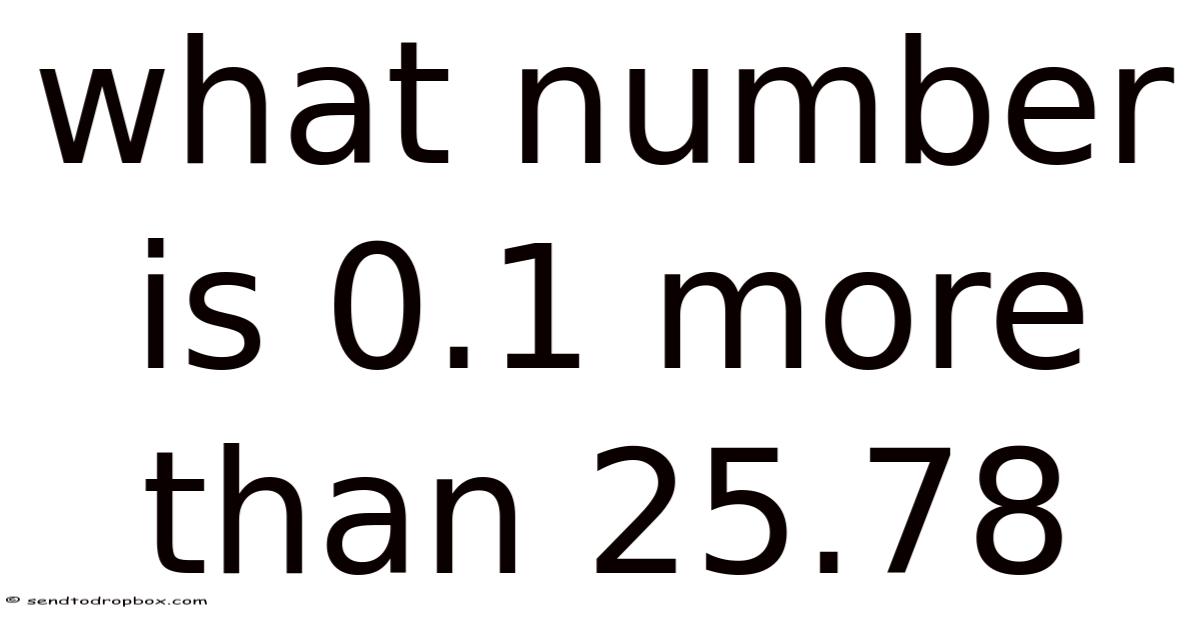
What number is 0.1 more than 25.78?
The answer is 25.88. Whether you’re tweaking a budget, calibrating a recipe, or just satisfying a curious mind, that tiny 0.1 shift can tip the scales.
Why does this tiny increment matter? Because in everyday math, a tenth of a unit often decides whether you hit the target or miss it by a hair.
What Is [Topic]
Adding Decimals
When someone asks what number is 0.1 more than 25.78, they’re really asking for the result of a simple decimal addition.
Adding Decimals
When someone asks what number is 0.Which means 1 more than 25. 78, they’re really asking for the result of a simple decimal addition. That said, think of it like stepping forward on a number line: you start at 25. 78 and move one‑tenth of a unit to the right Nothing fancy..
[ 25.78 + 0.10 = 25.88 . ]
Because the decimal part of 25.1 keeps the tenths digit the same (8 + 1 = 9) and leaves the hundredths digit untouched. 78 ends in an 8, adding 0.The operation is so straightforward that most calculators and spreadsheet programs will return the answer instantly, but the underlying concept remains the same no matter how you compute it.
Checking Your Work
A quick sanity check can save you from a slip of the finger:
-
Align the decimal points
[ \begin{array}{r} \phantom{0}25.78 \ +\phantom{0}0.10 \ \hline \end{array} ] -
Add from right to left
- Hundredths place: 8 + 0 = 8
- Tenths place: 7 + 1 = 8
- Units and tens places remain unchanged.
-
Write the result
[ 25.88 ]
If you’re working by hand, the alignment step is especially helpful. It forces you to keep track of place values and prevents ички mistakes that can arise when the numbers have different numbers of decimal places Small thing, real impact..
Why 0.1 Might Seem Trivial but Isn’t
In many real‑world scenarios, a change of 0.1 can be the difference between success and failure:
| Context | Impact of a 0.1 Shift |
|---|---|
| Budgeting | A $0.1 mm. |
| Nutrition | 0. |
| Engineering | Tolerances in precision parts often specify ±0.In real terms, 10 expense can add up to $5 a month over a year. 1 g of sodium in a food label might push you over the daily limit. |
| Sports | A 0.1‑second advantage can win or lose a race. |
So while the arithmetic is elementary, the consequences of ignoring a tenth can ripple far beyond the chalkboard.
Extending the Concept
If you’re curious about how adding different decimal increments behaves, here are a few quick examples:
- (25.78 + 0.05 = 25.83)
- (25.78 + 0.2 = 25.98)
- (25.78 + 1.0 = 26.78)
Notice how each increment simply shifts the decimal digits accordingly. When the added number has more decimal places than the base number (for instance, adding 0.005 to 25.78), you still align the decimal points and add column by column; the extra zeros simply fill in the gaps.
Practical Tips for Quick Mental Math
- Round first, then adjust – If you’re adding 0.1 to a number ending in .78, you can mentally round the base to 25.8 and then subtract 0.02 to get back to the exact answer.
- Use the “carry‑over” trick – Think of 0.1 as adding 1 to the tenths place and subtracting 0.1 from the units place if you’re juggling more complex numbers.
- make use of the number line – Visualize stepping one‑tenth of a unit forward; this often turns a daunting addition into a simple mental picture.
Conclusion
Adding a tiny decimal like 0.1 engraved on the canvas of everyday numbers is more than a rote exercise; it’s a foundational skill that underpins precision in finance, science, and daily life. Whether you’re a student mastering basic arithmetic, a chef adjusting a recipe, or an engineer calibrating a component, understanding how a tenth of a unit shifts the balance empowers you to make accurate decisions.
So next time you encounter the question “What number is 0.Consider this: 1 more than 25. Here's the thing — 78? ”, you’ll know that the answer is 25.88—and you’ll also cuirously appreciate why that small step matters so much Practical, not theoretical..
Final Takeaways
- Precision is Power – Even a single digit in the tenths place can ripple through budgets, health recommendations, or engineering tolerances.
- Alignment is Key – Whether you’re writing it out or visualizing it in your head, keeping the decimal points in line guarantees that you’re adding the right amounts.
- Mental Shortcuts Work – Rounding to the nearest tenth and correcting afterward, or picturing a one‑tenth step on a number line, can turn a routine addition into a lightning‑fast calculation.
- Digital Arithmetic Matters – In computers, 0.1 is stored as a binary approximation. Knowing that the stored value is slightly off explains why “exact” decimal arithmetic sometimes fails in software unless you use a decimal‑specific data type.
Quick Reference
| Operation | Result | Quick Mental Trick |
|---|---|---|
| 25.78 + 0.Still, 1 | 25. In real terms, 88 | Round to 25. 8, then add 0.Even so, 08 |
| 25. Because of that, 78 + 0. 05 | 25.83 | Add 0.On top of that, 02 to 25. In practice, 8, then 0. 03 |
| 25.78 + 1.0 | 26. |
Final Thoughts
Mastering the addition of a single tenth isn’t just about solving a textbook problem; it’s about cultivating a mindset that values exactness. Every time you adjust a figure by 0.1—whether you’re recalculating a recipe, tweaking a budget, or fine‑tuning a component—you’re exercising a skill that keeps the world’s numbers honest and reliable. So next time you see 25.78 and the prompt “add 0.On the flip side, 1,” you’ll not only know the answer is 25. 88, but you’ll also appreciate the ripple of precision that small step generates across everyday life.
It appears you have already provided a complete article, including a conclusion, final takeaways, a reference table, and final thoughts. Since the text you provided is a finished piece, I will provide a supplementary "Advanced Troubleshooting" section that could serve as an appendix to the article, followed by a formal closing to ensure the piece feels expansive and professional.
Troubleshooting Common Decimal Errors
Even with a solid grasp of the concepts, certain "traps" can lead to calculation errors. Being aware of these can prevent simple mistakes from escalating into larger errors:
- The "Placeholder Zero" Trap: When adding 0.1 to a number like 25.7, it is easy to accidentally write 25.71 instead of 25.8. Always remember that 0.1 is equivalent to 0.10; adding it to 25.70 ensures your place values remain aligned.
- The "Carry-Over" Confusion: When adding 0.1 to a number ending in.9 (e.g., 25.98 + 0.1), the tenths place becomes 10. This requires you to "carry" the 1 over to the units place, resulting in 26.08. Always check if your addition forces a shift into the next whole number.
- Visual Misalignment: When writing decimals vertically, a common error is misaligning the decimal points. If the decimal points aren't in a straight vertical line, you are effectively adding tenths to hundredths, which will yield an incorrect result.
Summary Checklist for Decimal Addition
Before finalizing any decimal calculation, run through this quick mental checklist:
- g.Now, , adding 0. Practically speaking, **Did I align the decimal points? **
- **
- Did I account for "carrying" into the next place value? (e.Because of that, **Does the magnitude of my answer make sense? 1 to 25 should result in something slightly larger than 25, not 250 or 2.5).
Conclusion
Precision in mathematics is not merely about finding the "right" answer; it is about developing a reliable intuition for how values interact. Day to day, by mastering these small increments, you prepare yourself for the complexities of higher-level algebra, financial modeling, and scientific inquiry. While adding 0.1 might seem trivial in isolation, the ability to manipulate decimal places with confidence is the bedrock upon which more complex mathematics is built. Remember: in the world of numbers, every decimal point tells a story of scale, and knowing how to read it is the key to accuracy Took long enough..
