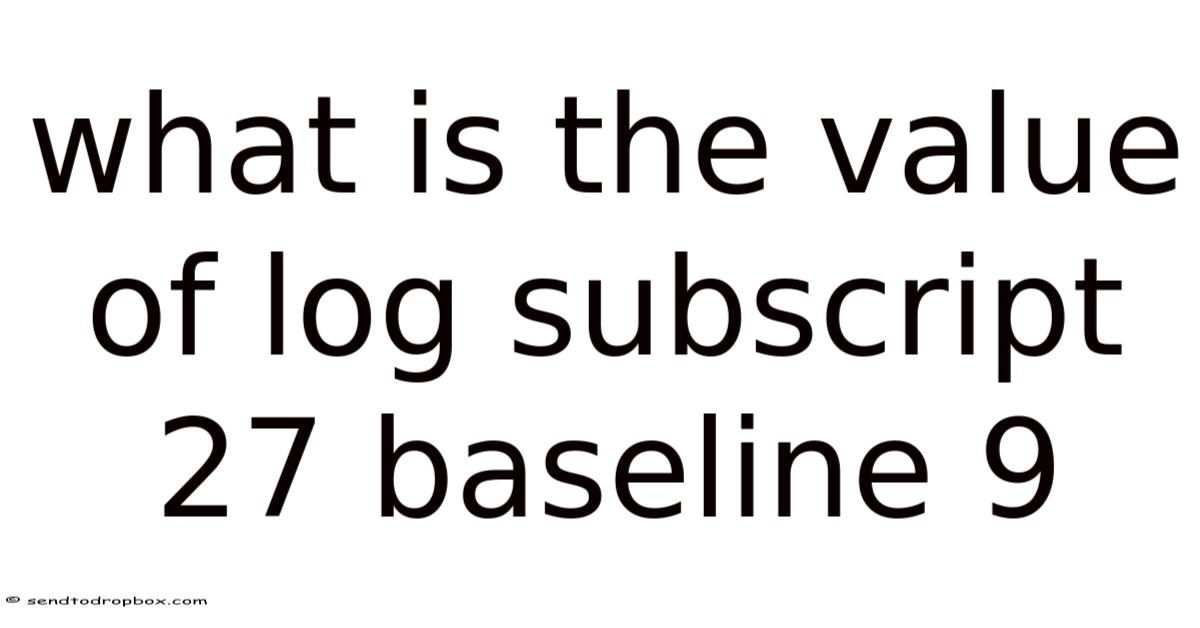
What Is the Value of Log Subscript 27 Baseline 9?
Here's the thing — logarithms can feel like a foreign language until you get the hang of them. And then, suddenly, they click. Still, you start seeing them everywhere: in computer algorithms, in measuring earthquakes, in financial growth models. But when someone throws a specific problem at you, like finding the value of log subscript 27 baseline 9, it’s easy to freeze Nothing fancy..
So let’s break it down. No jargon. No fluff. Just a clear path to understanding what this logarithm means and how to calculate it.
What Is Log Subscript 27 Baseline 9?
At its core, log subscript 27 baseline 9 is asking a simple question in mathematical disguise: To what power must 27 be raised to get 9?
In plain terms, we’re looking for a number — let’s call it x — such that 27^x = 9. Once you reframe it that way, it becomes less intimidating. It’s not about memorizing formulas; it’s about solving for an exponent.
This type of logarithm is written as log₂₇(9), where the subscript indicates the base (27) and the number inside the log is the result we’re working toward (9). While this might seem abstract, logarithms like this show up in all sorts of real-world applications, especially in fields dealing with exponential growth or decay.
This changes depending on context. Keep that in mind.
Understanding Logarithm Basics
Before diving deeper, let’s recap what logarithms do. They’re the inverse of exponentiation. If 2^3 = 8, then log₂(8) = 3. Simple enough. Now, apply that logic to log₂₇(9). We want to find x so that 27^x = 9.
But 27 and 9 aren’t random numbers. Practically speaking, they’re both powers of 3. That’s the key insight here.
Why It Matters / Why People Care
You might be wondering: why does this specific logarithm matter? In practice, real talk — it’s not just a textbook exercise. Worth adding: understanding how to manipulate logs with non-standard bases helps build intuition for more complex problems. It’s also foundational for topics like information theory, algorithm efficiency, and even music theory (yes, really) That's the part that actually makes a difference..
Every time you can quickly convert between different logarithmic bases or recognize patterns in exponents, you’re better equipped to tackle advanced math. More importantly, you avoid common pitfalls that trip up students and professionals alike.
Here's one way to look at it: in computer science, binary logarithms (base 2) are everywhere. But what if you’re dealing with a system that uses base 3 or base 27? Being able to translate between these systems is crucial. And in finance, compound interest formulas often require manipulating logs with unusual bases Not complicated — just consistent..
The official docs gloss over this. That's a mistake Not complicated — just consistent..
So while log₂₇(9) might look niche, the skills behind it are broadly useful.
How It Works: Calculating Log Subscript 27 Baseline 9
Let’s get into the math. There are a few ways to approach this, but I’ll walk through the most intuitive method first.
Step 1: Express Both Numbers as Powers of the Same Base
Notice that 27 = 3³ and 9 = 3². So we can rewrite the equation:
27^x = 9
(3³)^x = 3²
Using the exponent rule (a^m)^n = a^(mn), this becomes:
3^(3x) = 3²
Since the bases are the same, the exponents must be equal:
3x = 2
x = 2/3
So, log₂₇(9) = 2/3. That’s approximately 0.6667.
Step 2: Verify Using the Change of Base Formula
If you’re not convinced, let’s double-check with the change of base formula:
log_b(a) = ln(a) / ln(b)
Applying this to our problem:
log₂₇(9) = ln(9) / ln(27)
We can compute this using a calculator, but let’s simplify it algebraically. Again, express 9 and 27 as powers of 3:
ln(3²) / ln(3³) = (2 ln 3) / (3 ln 3) = 2/3
Same result. That’s reassuring Still holds up..
Step 3: Think in Terms of Exponents
Another way to internalize this is to think about what 27^(2/3) actually means. It’s the same as taking the cube root of 27 squared:
27^(2/3) = (∛27)² = 3² = 9
Which confirms our answer. This kind of cross-checking is invaluable when working with logarithms Less friction, more output..
Common Mistakes / What Most People Get Wrong
Here’s where things usually go sideways. Most people see log₂₇(9) and immediately reach for a calculator without thinking about the relationship between 27 and 9. They miss the fact that both are powers of 3, which makes the problem much simpler That alone is useful..
Others confuse log₂₇(9) with log₉(27). Which means those are inverse operations, and mixing them up leads to incorrect answers. Remember: the base is always the bottom number, and the argument is the top one That's the part that actually makes a difference..
Some also forget that logarithms are only defined for positive numbers. Here's the thing — trying to compute log₂₇(0) or log₂₇(-9) is a dead end. Always check your inputs The details matter here..
And here’s a sneaky one: assuming that log₂₇(9) is less than 1 because 9 is smaller than 27. But logarithms don’t work like subtraction. In fact, log₂₇(9
Assuming that log₂₇(9) must be less than 1 simply because the argument is smaller than the base is a subtle but common misinterpretation. In reality, the value of a logarithm tells you the exponent you must raise the base to in order to obtain the argument. Consider this: since 27^(2/3) equals 9, the exponent 2/3 is indeed less than 1, but this is a consequence of the specific relationship between the numbers, not a generic rule. In other bases, a smaller argument can produce a logarithm greater than 1 — consider log₃(27), where 27 is larger than 3 yet the logarithm equals 3 because 3³ = 27.
Practical Strategies for Tackling Unusual Bases
-
Factorization First
Identify a common prime factor among the numbers. In the example above, both 27 and 9 share the factor 3, which immediately suggests rewriting the problem in terms of powers of 3. This step often reduces the computation to simple integer arithmetic Simple as that.. -
Use Exponential Reasoning
Instead of reaching for a calculator, ask yourself: “What power of the base yields the argument?” For 27^x = 9, you can think of 27 as 3³ and 9 as 3², leading directly to 3^(3x) = 3² and thus 3x = 2. This mental shortcut saves time and reduces rounding errors And it works.. -
make use of the Change‑of‑Base Formula Judiciously
When the numbers are not easily expressed as powers of a common base, the change‑of‑base formula (log_b(a) = ln a / ln b) provides a reliable fallback. Modern calculators and spreadsheet software handle natural logarithms (or any other log base) with high precision, so the formula becomes a practical tool rather than a theoretical exercise. -
Cross‑Check with Roots and Powers
After obtaining a fractional exponent, verify it by converting it back to a root and power. As an example, 27^(2/3) can be viewed as (∛27)², which is 3² = 9. This sanity check catches algebraic slip‑ups and reinforces conceptual understanding.
Real‑World Contexts Where Unusual Bases Appear
-
Computer Science & Information Theory
While binary (base 2) dominates data representation, ternary (base 3) and higher‑order bases surface in error‑correcting codes, balanced ternary arithmetic, and certain hashing algorithms. Converting between these bases often requires logarithmic manipulation. -
Finance & Growth Modeling
Compound interest calculations can involve logarithms with non‑standard bases when modeling periodic contributions that occur on unconventional schedules (e.g., quarterly versus monthly). Understanding how to change bases enables accurate forecasting. -
Signal Processing
In digital signal processing, log‑scaled frequency axes (e.g., mel‑scale or bark‑scale) use arbitrary bases to map linear frequency ranges to perceptual scales. Converting between these scales relies on logarithmic properties with custom bases That's the whole idea.. -
Cryptography
Some asymmetric cryptographic schemes employ discrete logarithm problems in groups where the group order is a large prime or a product of primes, effectively introducing bases that are not powers of small integers. Mastery of logarithmic conversion techniques is essential for analyzing security margins Easy to understand, harder to ignore..
A Final Thought on Mastery
The ability to manage logarithms with unconventional bases is less about memorizing formulas and more about cultivating a flexible mindset. By recognizing common factor structures, visualizing exponentiation, and verifying results through inverse operations, learners build a strong toolkit that transcends any single example. This agility proves valuable not only in academic settings but also in any profession where quantitative reasoning underpins decision‑making.
Conclusion
Logarithms with bases other than 10 or e may initially appear esoteric, yet they embody the same fundamental principles that govern their more familiar counterparts. As demonstrated, the skills honed through these exercises ripple outward into diverse fields, from algorithm design to financial modeling. So avoiding typical pitfalls — misidentifying base and argument, overlooking the positivity constraint, and assuming monotonic relationships — further sharpens accuracy. By decomposing numbers into shared prime factors, applying the definition of logarithms, and employing the change‑of‑base formula when necessary, students and professionals can confidently evaluate expressions such as log₂₇(9). Embracing this versatility ensures that logarithmic reasoning remains a powerful, adaptable asset throughout one’s technical journey.
Some disagree here. Fair enough.
