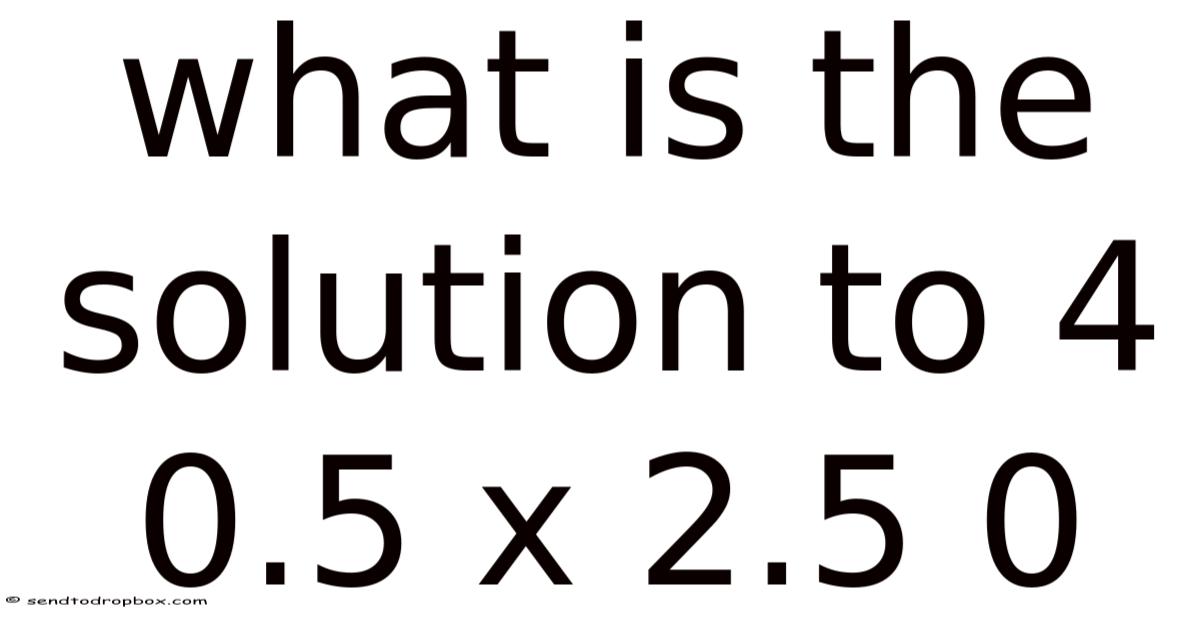
What Is the Solution to 4 ÷ 0.5 × 2.5 × 0?
Let’s start with a question that might make you pause: What happens when you mix division, multiplication, and a zero in the same math problem? It’s the kind of equation that feels simple at first glance but can trip you up if you’re not careful. The problem we’re tackling today is 4 ÷ 0.5 × 2.5 × 0. At first, it looks like a puzzle with a hidden trick—especially because of that zero at the end. But here’s the short version: the answer is zero. Let’s break down why, step by step Still holds up..
Why the Zero Changes Everything
When you see a zero in a multiplication problem, it’s like a reset button. No matter what numbers come before it, multiplying by zero always gives you zero. Think of it this way: if you have 10 apples and multiply them by zero, you suddenly have no apples. The same logic applies here. The equation ends with × 0, so even if the earlier operations seem complex, the final result is guaranteed to be zero That's the part that actually makes a difference..
But let’s not skip ahead. In practice, math isn’t about shortcuts—it’s about understanding why things work. So let’s walk through the problem the long way Simple, but easy to overlook. Still holds up..
Breaking Down the Order of Operations
The key to solving any equation is following the order of operations, often remembered by PEMDAS: Parentheses, Exponents, Multiplication and Division (from left to right), Addition and Subtraction (from left to right). In this case, there are no parentheses or exponents, so we focus on multiplication and division.
Starting with 4 ÷ 0.Practically speaking, 5:
Dividing by 0. 5 is the same as multiplying by 2. Why? Even so, because 0. 5 is half, and dividing by a half doubles the number. So, 4 ÷ 0.5 = 8 Surprisingly effective..
Next, we take that result and multiply by 2.5:
8 × 2.5 = 20.
Now, we’re left with 20 × 0.
And here’s the kicker: anything multiplied by zero equals zero.
Why This Matters in Real Life
You might be thinking, “Okay, cool, but why does this matter?” Math problems like this aren’t just abstract exercises. They reflect how systems work in the real world. For example:
- Finance: If a company’s revenue is multiplied by zero (e.g., during a shutdown), profits vanish.
- Engineering: A zero in a calculation could mean a system failure or a critical error.
- Everyday Life: Forgetting to account for a zero in a recipe (like using 0 cups of flour) would leave you with nothing.
The zero acts as a “nullifier,” erasing all prior calculations. It’s a reminder that in math—and in life—some elements have outsized impacts Simple, but easy to overlook..
Common Mistakes to Avoid
Even simple problems can lead to errors if you rush. Here are a few pitfalls to watch for:
- Ignoring the zero: Skipping the final multiplication by zero and assuming the answer is 20.
- Misapplying order of operations: Doing 0.5 × 2.5 first instead of left-to-right.
- Misinterpreting decimals: Thinking 0.5 is “half of 4” but forgetting to divide properly.
Let’s say you did 0.5 × 2.So 5 first. That would give 1.25, then 4 ÷ 1.Think about it: 25 = 3. 2, and finally 3.2 × 0 = 0. Either way, the zero still wins. But sticking to PEMDAS ensures you don’t second-guess yourself It's one of those things that adds up..
Practical Tips for Similar Problems
If you encounter equations like this in the future, here’s how to approach them:
- Spot the zero early: If there’s a × 0 anywhere in the problem, the answer is zero. Period.
- Simplify step by step: Break the equation into smaller parts (e.g., 4 ÷ 0.5, then × 2.5, then × 0).
- Double-check decimals: 0.5 might look like a small number, but it’s powerful in division.
Why People Struggle with This
The confusion often comes from how we’re taught math. We learn multiplication and division as separate operations, but in reality, they’re intertwined. Take this: dividing by 0.5 feels counterintuitive because it’s not a whole number. Many people instinctively reach for a calculator, but understanding the “why” behind the steps builds confidence.
Another factor is the psychological bias toward non-zero numbers. Day to day, our brains are wired to avoid “nothingness,” so seeing a zero at the end can feel like a trick. But in math, zero isn’t a trick—it’s a fundamental rule.
The Bigger Picture: Math as a Tool
This problem isn’t just about getting the right answer; it’s about training your brain to spot patterns. Math is less about memorization and more about recognizing relationships between numbers. For instance:
- Division by fractions: Always think, “How many times does this fit into that?”
- Multiplication by zero: A universal reset button.
- Left-to-right order: When operations have the same priority (like ÷ and ×), sequence matters.
These principles apply far beyond arithmetic. In algebra, calculus, and even coding, understanding how operations interact is critical.
Final Thoughts
So, to recap: 4 ÷ 0.5 × 2.5 × 0 = 0. The zero at the end ensures the result is zero, no matter what happens before it. But the journey to that answer teaches us about order of operations, the power of decimals, and the importance of attention to detail.
Next time you see a zero in an equation, don’t dismiss it. Embrace it. It’s there to teach you something important: that sometimes, the simplest elements have the biggest impact.
And if you’re still unsure, here’s a quick test: What’s 100 ÷ 2 × 5 × 0? Now, without doing the math, you already know the answer. Zero. Because math, at its core, is about clarity—and sometimes, clarity comes from the simplest of rules.
But beyond the arithmetic, there’s a deeper lesson hidden in that lone zero: context matters as much as the numbers themselves. In real‑world calculations, a zero can appear in any spot—inside a coefficient, as a result of a subtraction, or even as a placeholder in a decimal. The rule remains the same, but the implications can change the story entirely.
This changes depending on context. Keep that in mind It's one of those things that adds up..
Zero as a Placeholder
Consider a situation where you’re computing a profit margin:
( \frac{\text{Revenue} - \text{Cost}}{\text{Revenue}} ).
If the revenue happens to be exactly equal to the cost, the numerator becomes zero, and the entire fraction collapses to zero. That simple outcome ваҡытта a business is no profit at all. Recognizing this early can save you from chasing after more data or running unnecessary simulations.
Zero in Systems of Equations
When dealing with systems—think of simultaneous equations—zero can be the key that unlocks the solution.
Take the classic linear system:
[
\begin{cases}
3x + 4y = 12\
\
\
\
\
\
\
\
\
\
\
\
\
\
\
\
\
\
\
\
\
\
\
\
\
\end{cases}
]
If you find that one equation reduces to (0 = 0) after substitution, you’ve discovered a dependency, meaning the system has infinitely many solutions or none at all. That zero tells you that the equations are not independent.
When Zero Can Be Tricky
- Division by Zero – Always an error.
- Multiplying by Zero After a Division – As in the original problem, it guarantees a zero result, but it can mask a mistake if you forget to perform the division first.
- Floating‑Point Precision – In computer science, a number that should be zero might appear as (1 \times 10^{-15}). Always round appropriately before applying the zero rule.
Practical Checklist for Zero‑Heavy Calculations
| Step | What to Watch For | Quick Fix |
|---|---|---|
| 1 | Identify zeros early | Highlight them in the equation |
| 2 | Check operation order | Use parentheses if unsure |
| 3 | Verify intermediate results | Re‑calculate the preceding step |
| 4 | Validate with a calculator | Cross‑check the final answer |
The Takeaway
Zero is a powerful sentinel in mathematics. It doesn’t just represent the absence of quantity—it signals a boundary condition, a potential error, or a simplification that can save time and effort. By treating every zero with respect—spotting it early, honoring the order of operations, and recognizing its implications—you transform a potential stumbling block into an advantage.
In the end, the lesson from (4 \div 0.That said, 5 \times 0 = 0) extends far beyond the classroom. 5 \times 2.Now, whether you’re balancing budgets, coding algorithms, or solving differential equations, that humble zero will always be there, waiting to remind you that sometimes the simplest element can dictate the entire outcome. Embrace it, and let it guide you toward clearer, more efficient problem‑solving Worth knowing..
This is the bit that actually matters in practice.
