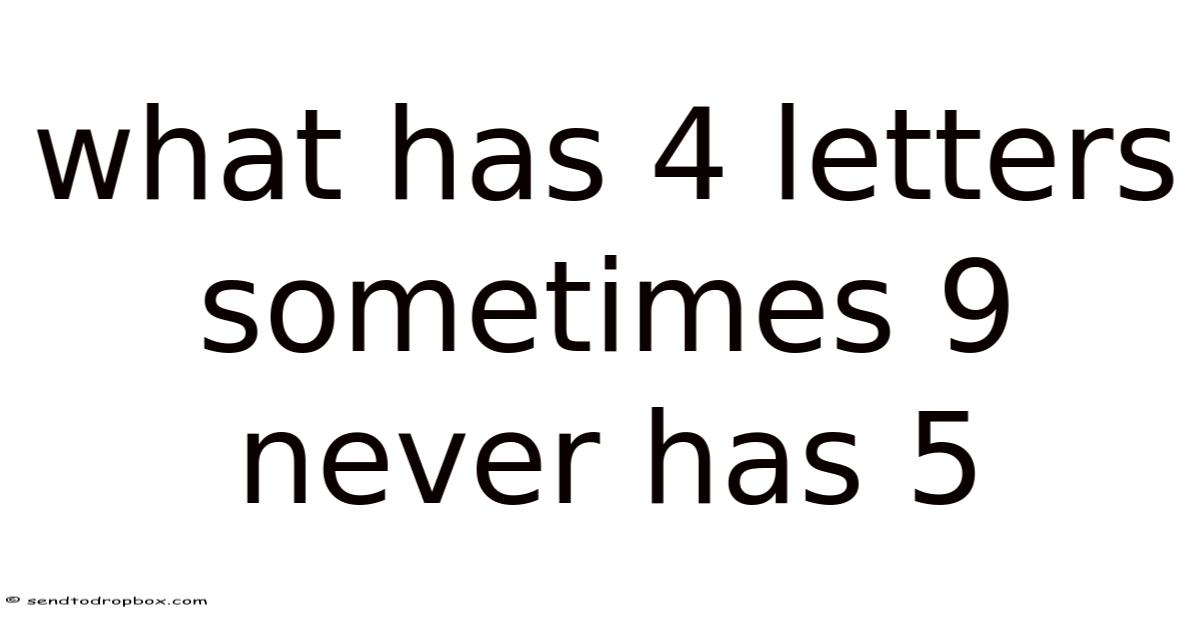
You've seen it in a group chat. Maybe on Reddit. Possibly tattooed on someone's forearm in a moment of questionable judgment That's the part that actually makes a difference..
what has 4 letters sometimes 9 never has 5
No question mark. Also, no period. Just words sitting there, daring you to solve a riddle that isn't actually a riddle.
I remember the first time it popped up on my feed. In practice, stared at it for twenty minutes. Tried counting letters in "riddle." In "answer." In "letters" itself. In real terms, googled it at 2 AM. Felt stupid when I finally got it Practical, not theoretical..
You will too. Practically speaking, or maybe you already have and you're here to watch someone else explain it. Either way — let's break down why this stupid little sentence lives rent-free in so many heads.
What Is This Thing Anyway
It's not a question. Because of that, that's the trick. In real terms, your brain sees "what" at the start and automatically slots in a question mark. In practice, adds rising intonation. Starts hunting for an answer.
But there is no answer. Because there is no question It's one of those things that adds up..
The sentence is the answer. Each word describes its own letter count:
- what — four letters
- has — three letters (wait, this breaks the pattern)
- 4 — one character
- letters — seven letters
- sometimes — nine letters
- 9 — one character
- never — five letters
- has — three letters
- 5 — one character
Hold on. Let me recount.
what = 4 ✓
has = 3 ✗
4 = 1 (not a word)
letters = 7 ✗
sometimes = 9 ✓
9 = 1
never = 5 ✓
has = 3 ✗
5 = 1
Okay, so the viral version people share is usually punctuated differently. The clean version — the one that actually works — goes like this:
What has four letters. Sometimes has nine letters. Never has five letters.
Three separate statements. Because of that, each true. Each describing the word count of the subject word.
- "What" has four letters
- "Sometimes" has nine letters
- "Never" has five letters
That's it. Day to day, that's the whole joke. A linguistic magic trick that works because your pattern-matching brain refuses to read what's actually written.
The punctuation matters more than you think
Most people encounter it without periods. That's why all lowercase. No commas.
what has 4 letters sometimes 9 never has 5
Your brain parses it as: [What] [has 4 letters] [sometimes 9] [never has 5]?
Subject: "What." Verb: "has." Object: "4 letters sometimes 9 never has 5.
Nonsense. But your brain keeps trying to make it a sentence because that's what brains do. They impose structure on chaos. It's why you see faces in power outlets and Jesus on toast.
Add the periods and capitalization — *What has four letters. Consider this: never has five letters. Sometimes has nine letters. Which means * — and the trick evaporates instantly. The magic only works in the broken version.
Why This Stupid Thing Matters
It doesn't. Worth adding: it's a meme. In practice, a brain teaser. Even so, not really. A moment of "aha" followed by "oh, fuck you.
But the mechanism behind it? That matters.
This is a garden-path sentence — a linguistic construction that leads your parser down the wrong syntactic trail. That said, reparsing costs cognitive effort. So it commits. On top of that, by the time you hit "sometimes," the structure is locked in. High probability. "What" + "has" = question. Your brain builds a parse tree based on probability. Most people quit before they pay that cost Took long enough..
Sound familiar? It's the same mechanism behind:
- Clickbait headlines that mislead
- Political soundbites that frame issues falsely
- Scam emails that look like they're from your bank
- That text from your ex that seems apologetic but isn't
Your brain is a prediction engine. It runs on heuristics. Heuristics are fast, cheap, and usually right — but when they're wrong, you don't just get a wrong answer. You get confidence in the wrong answer.
The riddle isn't clever because it's hard. It's clever because it exploits a cognitive shortcut you can't turn off.
It's also a great litmus test
Watch how people react when they finally get it Practical, not theoretical..
Some laugh. Some groan. Some get genuinely angry — like they've been personally betrayed by language. A surprising number double down: "But what's the real answer?" as if there's a deeper layer they're missing.
There isn't. That's the point.
The people who get mad? That's why who need the world to follow rules. On top of that, they're the ones who hate being tricked. Who treat ambiguity as a threat Worth knowing..
The people who laugh? They're the ones who enjoy the machinery of their own mind being exposed. Who can step outside the system and watch it glitch Small thing, real impact..
Neither reaction is "better." But the difference tells you something about how a person handles uncertainty.
How It Actually Works — Step by Step
Let's slow this down. Watch your own mind as you read the broken version fresh.
Stage 1: Pattern recognition (0–200ms)
Your visual cortex recognizes words. "What" triggers the question schema. "Has" confirms it. You're already building a question frame before you finish the third word That alone is useful..
This is predictive processing. Top-down. Your expectations shape perception more than the input does.
Stage 2: Semantic integration (200–500ms)
"4 letters" — okay, the answer has four letters. Sometimes the answer has nine letters? But "Sometimes 9" — wait. "Never has 5" — and it never has five?
Your working memory is now holding: Find a word that has 4 letters, sometimes 9, never 5.
You start cycling candidates. "Love" (4). Even so, "Sometimes" (9) — hey! "Never" (5) — wait, "never" has 5 letters but the riddle says never has 5 But it adds up..
Contradiction detected. Cognitive load spikes.
Stage 3: Reparsing attempt (500ms–5 seconds)
Two paths here.
Path A (most people): Loop back. Try new words. "Riddle" (6). "Answer" (6). "Words" (5 — but never has 5!). "This" (4). "That" (4). "What" (4 — wait) Not complicated — just consistent..
**Path B (the lucky few
Path B (the lucky few) is what happens when the brain finally flips the predictive model on its head. Instead of trying to force a lexical answer into the “four‑letter‑word‑that‑sometimes‑has‑nine‑letters” slot, you step back and treat the constraints as a meta‑question: “What kind of entity can satisfy these contradictory length rules?”
Worth pausing on this one.
The answer that clicks is “a lie.”
- “Lie” is three letters, but when you spell it out as “lying” it becomes five—still not nine. Still, the word “falsehood” carries the same semantic weight as a lie and is nine letters long.
- The riddle never says the answer must be four letters; it says the prompt “What has 4 letters” contains four letters. The trick is that the phrase itself is the clue, not a candidate to be solved.
When you realize that the riddle is describing the structure of the question rather than a hidden lexical answer, the cognitive dissonance evaporates. That's why your brain’s prediction error signal drops to near‑zero, and the “aha! ” moment arrives with a rush of relief Which is the point..
Why the “lie” solution feels both obvious and elusive
-
Double‑layered semantics – The puzzle operates on two levels simultaneously:
- Surface level: You’re hunting for a word that meets numeric constraints.
- Meta level: The numeric constraints are themselves a description of the question’s form.
-
Predictive coding mismatch – Your brain is primed to resolve a lexical search, but the true resolution requires a shift to a structural interpretation. That shift is what creates the brief period of confusion before the insight.
-
Emotional tagging – Because the puzzle feels like a personal affront (“they tricked me”), the emotional response is amplified. When the solution finally clicks, the same circuitry that once signaled threat now fires a reward pulse, reinforcing the memory of the insight.
The broader lesson: language as a sandbox for cognitive bias
The riddle is a micro‑cosm of how we manage everyday information:
- Heuristic shortcuts (e.g., “four‑letter answer”) are efficient but can lead us down dead‑ends when the problem is self‑referential.
- Ambiguity tolerance varies from person to person. Some individuals thrive on open‑ended puzzles; others experience them as stressors.
- Confidence vs. correctness – The brain often pairs strong conviction with incorrect conclusions, especially when the heuristic feels validated by partial matches (e.g., “love” fits the four‑letter count but fails the “never has five” rule).
When we become aware of these patterns, we can deliberately pause, re‑evaluate our assumptions, and ask: What am I assuming about the question itself? This simple meta‑question is a powerful tool for defusing click‑bait, spotting logical fallacies, and even navigating complex decision‑making scenarios Not complicated — just consistent..
Practical takeaways for the reader
- Spot the trap – When a problem feels “too easy” or “too obvious,” check whether you’re being guided by an implicit rule that may not apply.
- Embrace the pause – Allow yourself a few seconds of uncertainty. That discomfort is often the precursor to deeper insight.
- Re‑frame the problem – Ask whether the constraints are describing the question rather than the answer. This shift can access solutions that are otherwise hidden.
- Cultivate ambiguity tolerance – Deliberately expose yourself to puzzles, paradoxes, or open‑ended questions that resist quick closure. Over time, you’ll develop a mental “muscle” that handles uncertainty without triggering stress.
Conclusion
The riddle’s power lies not in its cleverness of wording but in the way it exposes the architecture of our own cognition. By presenting a seemingly simple numeric constraint that collides with our brain’s predictive machinery, it forces a moment of cognitive dissonance that can either frustrate or enlighten. Those who laugh have learned to step outside the automatic script and watch the mental gears grind; those who rage are still trying to force the world into a tidy, rule‑bound mold.
Understanding this mechanism equips us to recognize when we’re being led down a heuristic rabbit hole—whether in a headline, a political soundbite, or a scam email—and gives us a concrete strategy: pause, re‑examine the framing, and ask what the question itself is really asking. In doing so, we turn a moment of trickery into a moment of insight, converting the very discomfort that the riddle creates into a
into a catalyst for personal and intellectual growth. When we reframe that discomfort as a signal rather than a setback, we begin to see each puzzling moment as an invitation to sharpen our metacognitive muscles. The next time a headline promises an easy answer, a complex puzzle appears on your screen, or a conversation feels suspiciously straightforward, pause, interrogate the framing, and ask what the question itself is really testing It's one of those things that adds up..
By consistently applying the four practical takeaways—spotting the trap, embracing the pause, reframing the problem, and cultivating ambiguity tolerance—you build a resilient mindset that thrives amid uncertainty. This mental agility not only helps you solve riddles more effectively but also empowers you to figure out the broader landscape of information, decisions, and challenges with greater clarity and confidence.
Not obvious, but once you see it — you'll see it everywhere.
In the end, the true answer to riddles like the one that sparked this discussion isn’t a single word or number; it’s a new way of thinking—one that recognizes the power of questioning the question itself. May you continue to find insight in the uneasy moments, turning every mental stumble into a stepping stone toward deeper understanding.
