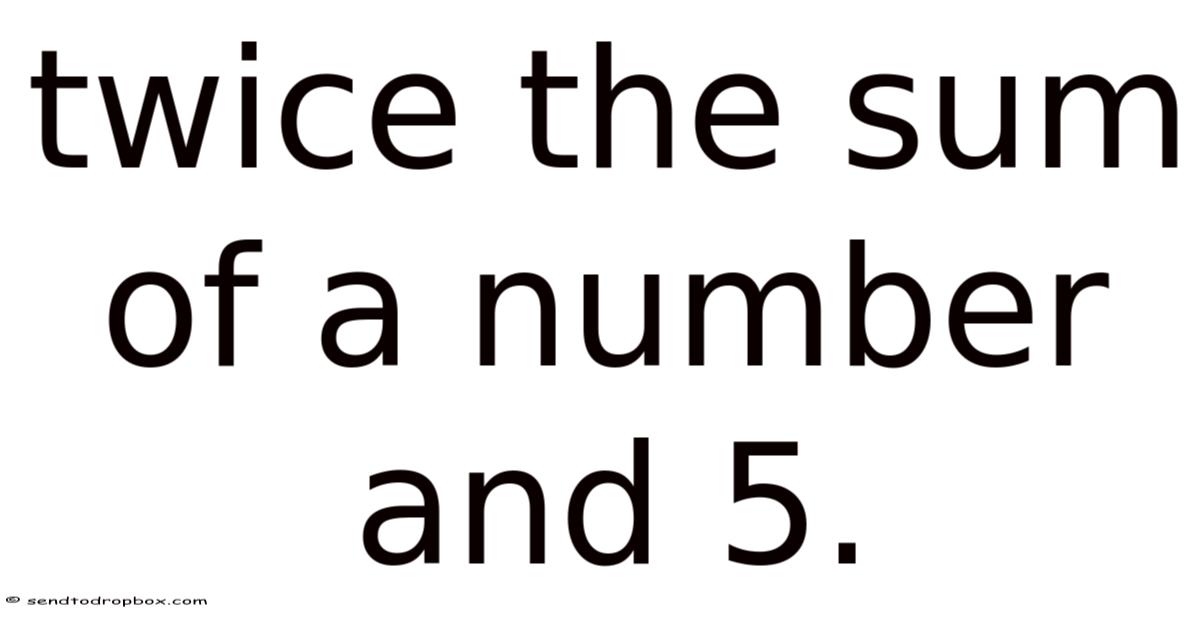
You’re staring at a worksheet that says “twice the sum of a number and 5 equals 22.” Your first thought might be, “What does that even mean?That said, ” It looks like a jumble of words, but behind it is a simple idea that shows up in everything from cooking recipes to calculating interest. If you’ve ever wondered how to turn a sentence like that into something you can actually work with, you’re in the right place.
What Is Twice the Sum of a Number and 5
At its core, the phrase is just an algebraic expression. Because of that, take a number — we’ll call it (n) for now — add five to it, then multiply the whole result by two. In symbols that looks like (2(n+5)). If you distribute the two, you get (2n+10). Both forms say the same thing; one keeps the addition inside the parentheses, the other spreads the multiplication out.
The Parts of the Expression
Breaking it down helps you see why each piece matters. The “sum of a number and 5” is the inner part, (n+5). That’s just a shift: whatever your number is, you move it up five steps on the number line. The word “twice” tells you to take that shifted value and double it. So you’re not just doubling the original number; you’re doubling the number after you’ve added five Simple, but easy to overlook..
Real talk — this step gets skipped all the time.
Why the Parentheses Matter
If you drop the parentheses and write (2n+5), you’ve changed the meaning entirely. That would be “twice a number, then add five,” which is not what the original phrase says. The parentheses force you to do the addition first, then the multiplication — exactly how the language is structured Easy to understand, harder to ignore..
Alternative Forms
Sometimes it’s useful to see the expression in its expanded form, (2n+10). It makes it clear that the expression is linear: as (n) grows, the output grows at a steady rate of two for every increase in (n), and it starts at ten when (n) is zero. The factored form, (2(n+5)), highlights the shift and the scaling together, which can be handy when you’re trying to factor or solve equations.
Why It Matters / Why People Care
You might think an expression like this lives only in math class, but it pops up whenever you need to scale something that already has an offset. In practice, imagine you’re preparing a batch of soup that calls for five ounces of broth per serving, and you want to make twice as many servings as the recipe calls for. If the original recipe serves (n) people, you need twice the sum of (n) and five ounces — exactly our expression Easy to understand, harder to ignore..
In finance, think of a base fee of five dollars plus a per‑item charge. If you want to know the cost for twice the number of items, you again end up with (2(n+5)). Even in physics, when you’re dealing with a starting offset and then scaling the whole situation, this pattern shows up.
Understanding it lets you translate word problems into symbols quickly, check your work by plugging numbers back‑the wrong operations. It’s a building block for more complicated formulas, and missing the nuance can lead to answers that are off by a constant — something that’s easy to miss but costly in real‑world applications.
How It Works (or How to Do It)
Working with the expression involves three typical tasks: evaluating it for a given number, solving equations where it equals something, and rewriting it in different forms. Each task reinforces a slightly different skill set.
Evaluating the Expression
If you know the value of (n), you just substitute and follow the order of operations. Say (n=3). First compute the sum: (3+5=8). Then double it: (2\times8=16). Even so, you could also use the expanded form: (2\times3+10=6+10=16). Both routes give the same answer, and checking both ways is a good habit to catch slips Simple, but easy to overlook. Turns out it matters..
Honestly, this part trips people up more than it should.
Solving Equations Involving the Expression
Often you’ll see something like (2(n+5)=22). To find (n), you undo the operations in reverse order. First divide both sides by two: (n+5=11). Then subtract five: (n=6) And that's really what it comes down to..
If you have an equation such as (2(n+5)=22), the goal is to isolate (n) by reversing the operations that were applied to it. Start by dividing both sides by the coefficient outside the parentheses:
[ \frac{2(n+5)}{2}= \frac{22}{2};\Longrightarrow; n+5=11. ]
Next, undo the addition inside the parentheses by subtracting five from each side:
[ n+5-5 = 11-5 ;\Longrightarrow; n=6. ]
A quick verification—substituting (n=6) back into the original expression—confirms the solution:
[ 2(6+5)=2\times11=22. ]
When the equation is presented in expanded form, (2n+10=22), the same steps appear slightly different but lead to the same result: subtract ten, then divide by two. Practicing both routes reinforces flexibility and helps catch algebraic slips early And that's really what it comes down to..
Rewriting the Expression
Beyond evaluation and solving, the expression can be manipulated to reveal hidden structure. Here's a good example: completing the square isn’t necessary here because the expression is already linear, but factoring out a common divisor highlights the scaling factor:
[ 2(n+5)=2\cdot n + 2\cdot5. ]
If you ever need to express the same relationship with a different baseline—say, shifting the offset from five to another constant (k)—you can rewrite it as
[ 2(n+k)=2n+2k, ]
showing that the slope (the coefficient of (n)) remains unchanged while the intercept adjusts proportionally. This property is useful when aligning multiple linear models that share the same rate of change but start from different baselines Simple as that..
Connecting to Broader Concepts
The pattern “twice the sum of a variable and a constant” is a simple instance of an affine transformation: (f(n)=a n + b) with (a=2) and (b=10). Recognizing an expression as affine lets you apply a toolbox of techniques—graphing as a straight line, interpreting the slope as a rate of change, and using intercepts to predict behavior at (n=0). In data analysis, fitting a line to observed points often yields coefficients that resemble this form, and understanding how to move between factored and expanded representations speeds up model inspection and adjustment That alone is useful..
Practical Tips
- Check both forms – After evaluating or solving, switch between (2(n+5)) and (2n+10) to verify consistency.
- Undo operations in reverse – When solving, always peel away the outermost operation first (here, the multiplication by 2).
- Watch the offset – The constant term (five inside the parentheses, ten after expansion) is a common source of error; a misplaced sign shifts the entire result by that amount.
- Use units – If (n) represents a quantity with units (e.g., servings, items, seconds), carry those units through each step to ensure the final answer is dimensionally correct.
In a nutshell, the expression (2(n+5)) may appear modest, but it encapsulates a fundamental linear relationship that recurs in everyday calculations—from recipes and budgets to physics and finance. Practically speaking, recognizing its structure lets you translate word problems swiftly, verify your work confidently, and avoid the subtle constant‑offset mistakes that can otherwise derail real‑world applications. Think about it: by mastering how to evaluate, manipulate, and solve equations involving this form, you build a reliable foundation for tackling more layered algebraic models. Embrace the simplicity, practice the flexibility, and let this building block support your mathematical toolkit.
By internalizing the mechanics of (2(n+5)) you gain more than a quick‑calc tool; you develop a mental shortcut that translates any “double the sum of something and a fixed number” situation into a reliable, step‑by‑step process. The next time you encounter a problem that asks you to “multiply the total of a quantity and a constant by two,” you’ll instinctively reach for the distributive property, isolate the variable, and verify your result with confidence It's one of those things that adds up..
Putting it into practice
Imagine you are planning a community event that requires two tables for every pair of guests plus an extra five chairs per table. If (g) denotes the number of guest pairs, the total chairs needed can be expressed as (2(g+5)). Expanding gives (2g+10), making it trivial to compute the exact count for any (g) you choose That's the part that actually makes a difference..
Looking ahead
When you move beyond single‑step linear expressions, the same principles reappear in systems of equations, piecewise functions, and even in the formulation of linear regression models. Recognizing that each new variable you introduce can be treated as a “new (n)” with its own constant offset will keep your algebraic instincts sharp Not complicated — just consistent..
Final thought
Algebra is a language of patterns; the more patterns you decode, the more fluent you become in translating real‑world scenarios into precise mathematical statements. Mastering the modest expression (2(n+5)) is a stepping stone toward that fluency, and each subsequent problem you solve builds on the same foundational skills. Keep practicing, stay curious, and let each new equation remind you that every complex situation can be broken down into a series of simple, repeatable steps.
