The Math Problem That Trips Up Students (And Why It Shouldn't)
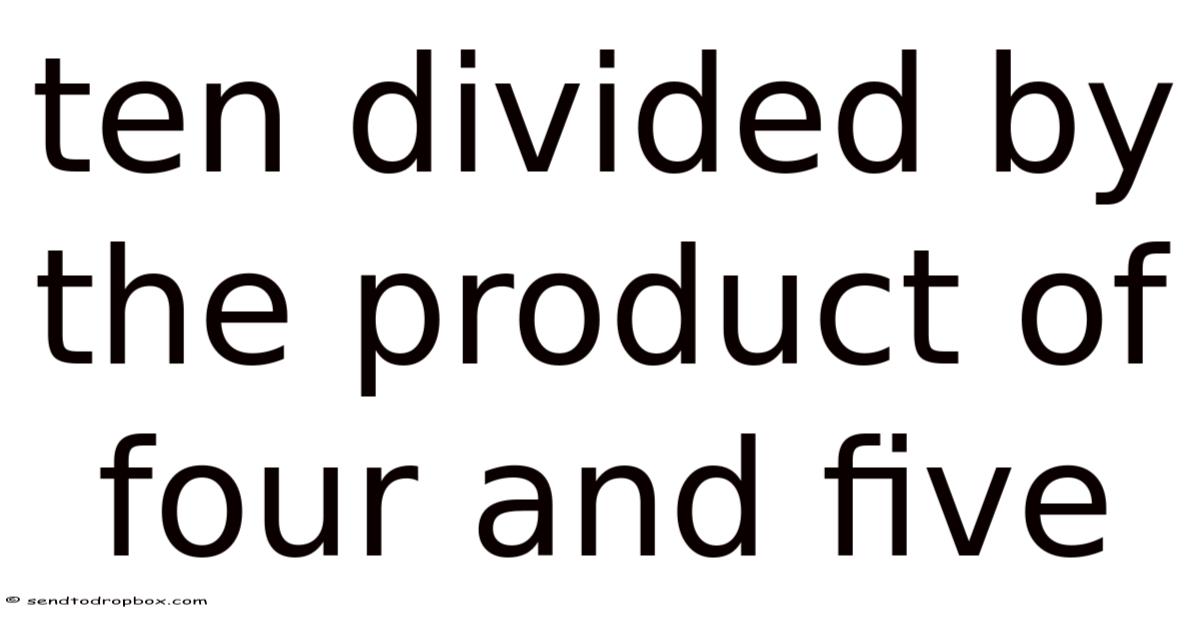
Ten divided by the product of four and five. It sounds like a riddle, doesn't it? Say that out loud a few times. The confusion usually isn't in the math itself — it's in the translation. But it's actually a straightforward arithmetic expression that shows up all the time in math classes, standardized tests, and real-world problem-solving. Turning words into numbers is where most people stumble Surprisingly effective..
Here's the thing: this isn't really about memorizing formulas or drilling multiplication tables. It's about reading carefully and understanding what "product" means in context. Once you get that part, the rest is just arithmetic.
What Is "Ten Divided by the Product of Four and Five"?
Let's break this down like we're explaining it to someone who hasn't touched math since high school. Because of that, the phrase "the product of four and five" is the key piece here. In mathematics, "product" always means multiplication. So the product of four and five is simply 4 × 5, which equals 20 That alone is useful..
Short version: it depends. Long version — keep reading.
Now the full expression becomes: ten divided by 20, or 10 ÷ 20. And that's 0. 5, or one-half, or 50% — however you want to express it And that's really what it comes down to. Simple as that..
Why the Order Matters
This is where people get tripped up. The phrase "ten divided by the product of four and five" has a very specific structure. And the word "of" in mathematics typically signals grouping — it tells you to do that operation first. So you calculate the product (4 × 5 = 20) before you divide Surprisingly effective..
If someone said "ten divided by four, times five," that would be a completely different calculation: (10 ÷ 4) × 5 = 12.5. The order changes everything.
Parentheses Make It Clear
In mathematical notation, we'd write this as:
10 ÷ (4 × 5) = 10 ÷ 20 = 0.5
The parentheses around "4 × 5" show that this multiplication happens before the division. On the flip side, without them, the expression would be ambiguous. Always look for those grouping clues in word problems — they're telling you the intended order of operations.
Why This Matters Beyond the Classroom
You might be thinking: "When am I ever going to need this?" Fair question. But this type of problem-solving shows up more often than you'd expect Easy to understand, harder to ignore. That's the whole idea..
Real-World Applications
Think about cooking or baking. If you need to scale a recipe down by a factor that involves multiple steps, you're essentially doing the same kind of calculation. But a recipe calls for ingredients in specific ratios. Maybe you need to divide your flour quantity by the combined adjustment factors for serving size and desired consistency.
Or consider budgeting. So you might need to divide your monthly savings by the product of your debt repayment terms and interest calculations. The structure is the same, even if the numbers look different.
Building Logical Thinking Skills
More importantly, problems like this train your brain to parse complex information and identify the correct sequence of operations. That skill — breaking down a complex instruction into manageable steps — is valuable whether you're debugging code, planning a project, or making investment decisions.
How to Solve This Step by Step
Let's walk through the process methodically. This approach works for any similar word problem you encounter Worth keeping that in mind..
Step 1: Identify the Key Terms
Read the entire expression first. Circle or highlight operation words:
- "Divided by" means division
- "Product" means multiplication
- "Of" usually indicates grouping (do this part first)
Step 2: Translate Words Into Numbers
Replace the verbal description with mathematical symbols:
- "Ten" becomes 10
- "Divided by" becomes ÷
- "The product of four and five" becomes (4 × 5)
Step 3: Apply Order of Operations
Remember PEMDAS (Parentheses, Exponents, Multiplication and Division, Addition and Subtraction). And the parentheses around the multiplication mean you do that first:
- Calculate 4 × 5 = 20
- Then calculate 10 ÷ 20 = 0.
Step 4: Check Your Work
Plug your answer back into the original context. Consider this: does 0. 5 make sense? Ten divided by something larger than ten should give you a fraction — yes, that checks out.
Common Mistakes People Make
I've seen these errors countless times, both in classrooms and online forums. They're so common that recognizing them can save you minutes of frustration.
Forgetting What "Product" Means
Some students see "product" and automatically think addition. Because of that, they'll calculate 4 + 5 = 9, then divide 10 by 9. That's why that gives roughly 1. Plus, 11, which is wrong. "Product" specifically means multiplication — always.
Ignoring Grouping Clues
Others jump straight to left-to-right calculation without respecting the implied grouping. 5). 5), then multiply by 5 (getting 12.In real terms, they'll do 10 ÷ 4 first (getting 2. The word "of" and the structure of the sentence clearly indicate that the multiplication should happen first And that's really what it comes down to..
Confusing Similar-Sounding Phrases
"Ten divided by the product of four and five" is different from "ten divided by four, multiplied by five.Day to day, " The first gives 0. 5; the second gives 12.5. Learning to hear the difference in phrasing is crucial.
Practical Tips That Actually Work
Here are the strategies I've seen work best, whether you're helping a child with homework or refreshing your own math skills.
Underline the Operation Words
Get in the habit of marking up word problems. Underline "product," "divided by," "sum," "difference" — whatever operation words appear. This visual cue helps your brain process the structure correctly.
Draw It Out
Sometimes drawing a simple diagram helps. For this problem, you could draw:
10 ÷ (4 × 5) = ?
Visual separation makes the grouping obvious.
Practice with Variations
Try changing the numbers but keeping the structure:
- 15 divided by the product of 3 and 5 = 15 ÷ 15 = 1
- 20 divided by the product of 4 and 2 = 20 ÷ 8 = 2.5
This builds familiarity with the pattern without getting stuck on specific numbers.
Use a Calculator Strategically
Don't reach for the calculator first. Do the mental math for simple parts (like 4 × 5 = 20), then use the calculator for the final division if needed. This builds number sense and catches errors Practical, not theoretical..
Frequently Asked Questions
What does "product" mean in math? Product means multiplication. The product of two numbers is what you get when you multiply them together Nothing fancy..
Do I always do multiplication before division? Not necessarily. You follow the order of operations: parentheses first, then multiplication and division from left to right as they appear The details matter here..
How do I know when something should be grouped? Look for words like "of," "times," "product," or phrases that describe a combined operation. These usually indicate grouping.
What's the answer to ten divided by the product of four and five? The answer is 0.5, or one-half.
Can I write this as a fraction? Yes. 10 ÷ (4 × 5) = 10/20 = 1/2 Worth keeping that in mind. That's the whole idea..
The Bigger Picture
Math anxiety is real, and it often stems from feeling like you're missing something obvious that everyone else understands. But here's what I've learned from years of working with students: most math problems aren't inherently difficult. They're just unfamiliar Worth knowing..
"Ten divided by the product of four and five" sounds intimidating because it's phrased as a complete sentence rather than a clean equation. But strip away the language, and you're left with basic arithmetic that you've been doing for years.
The trick isn't memorizing more rules — it's translating carefully and trusting the process. Read the problem, identify the operations, respect the grouping, and work through it step by step. Most importantly, don't let the wording make you nervous. Underneath, it's just numbers doing what numbers do.
That's the secret nobody tells you: math isn't about brilliance.
