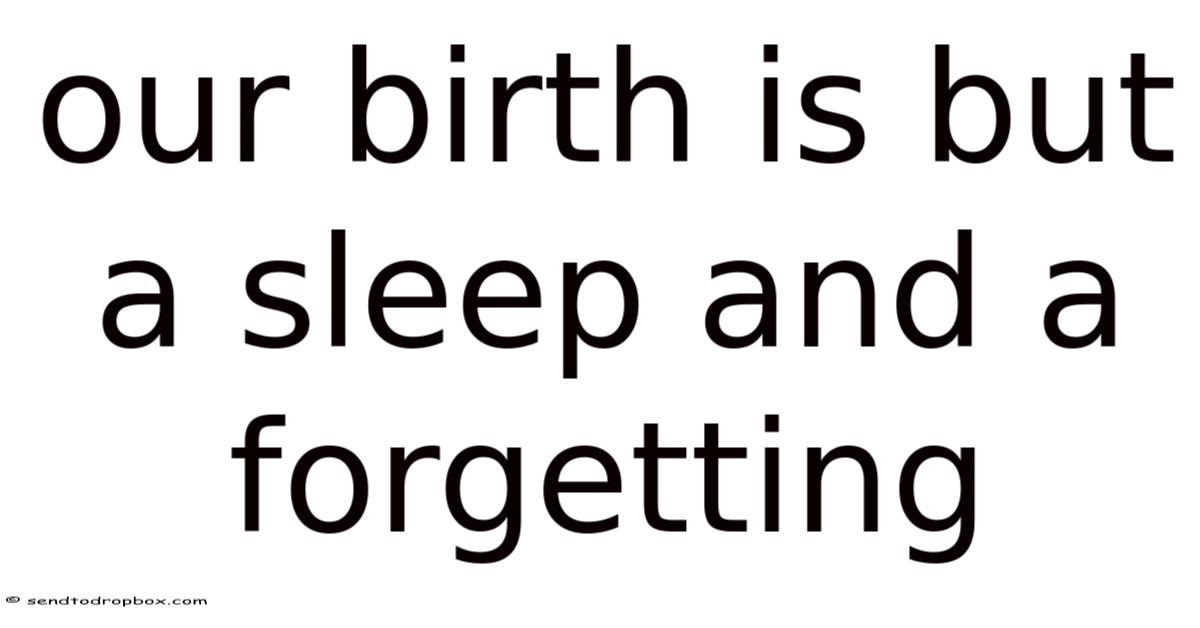
That line hits different depending on what decade you're in.
When you're twenty, it sounds like poetry — pretty, melancholic, the kind of thing you underline in a used paperback and forget by Tuesday. By forty, it starts to feel like a diagnosis. You catch yourself in the kitchen, reaching for a mug that isn't there, realizing you've forgotten the name of your first-grade teacher. Now, the smell of rain on hot asphalt. The exact weight of your father's hand on your shoulder the last time you saw him healthy.
Wordsworth wrote it in 1804. Two centuries later, it still lands like a stone in deep water.
What Is This Line and Where Does It Come From
The full stanza reads:
Our birth is but a sleep and a forgetting:
The Soul that rises with us, our life's Star,
Hath had elsewhere its setting,
And cometh from afar:
Not in entire forgetfulness,
And not in utter nakedness,
But trailing clouds of glory do we come
From God, who is our home.
It's from Ode: Intimations of Immortality from Recollections of Early Childhood. That's why catchy title. The poem runs 208 lines. Most people know only this stanza. Still, maybe the one about the child as "Mighty Prophet! Seer blest!
Wordsworth was thirty-four when he started it. Worth adding: he'd already lived through the French Revolution's collapse, watched his radical youth curdle into something quieter, harder. Even so, he'd lost two children by the time he finished the ode in 1806. The line isn't abstract philosophy. It's grief wearing a metaphysical coat.
The Platonic Echo You Didn't Ask For
Here's the thing — Wordsworth didn't invent the idea. So he borrowed it from Plato's Meno and Phaedo, where Socrates argues that learning is actually recollection (anamnesis). The soul, before birth, knew the Forms — Justice, Beauty, Truth. Birth is the river Lethe. Practically speaking, we drink. We forget. Philosophy is the long swim back upstream.
Wordsworth Christianized it. Swapped the Forms for God. Made it personal. The "clouds of glory" aren't abstract ideals — they're the specific light of a specific childhood. The daffodils. The hill behind the house. The way morning smelled before you knew words for it Worth keeping that in mind..
Why This Line Has Survived Two Centuries
Because it names something everyone feels but almost no one says out loud.
We're born trailing something. Call it soul, call it nature, call it the uncorrupted self — there's a before that we can't remember but keep bumping into. A smell. A chord progression. That said, the angle of light through trees at 4 PM in October. Your chest tightens. So naturally, you don't know why. You'll never know why Not complicated — just consistent..
That's the "sleep and forgetting" doing its work.
The Modern Version Looks Different
Now we talk about attachment theory and developmental windows and epigenetic inheritance. The vocabulary changed. The experience didn't Took long enough..
A baby knows things it can't articulate. It knows the rhythm of its mother's heartbeat better than it will ever know its own name. So then language arrives. The world becomes this and that, mine and yours, past and future. It knows when it's safe. Categories harden. The seamless field fractures But it adds up..
Neuroscience calls it synaptic pruning. The brain deletes what it doesn't use. But efficiency. Day to day, survival. But something gets lost in the edit — the raw, unmediated contact Wordsworth called "clouds of glory Simple, but easy to overlook. Turns out it matters..
What the Metaphor Actually Means (And What It Doesn't)
People read "sleep and forgetting" as passive. Like we're just unconscious for a while and wake up empty. That's not it.
Sleep Isn't Nothing
Sleep is work. Memory consolidation. Metabolic repair. And dreaming — whatever dreaming is, the brain is furiously active. The "sleep" of pre-birth or early infancy isn't a void. It's a different mode of knowing. Implicit. Embodied. Non-verbal. The forgetting isn't erasure — it's translation loss. Worth adding: you can't carry the pre-linguistic world into language intact. The container doesn't survive the transfer.
The "Clouds of Glory" Are Specific
This matters. On the flip side, wordsworth doesn't say we come trailing abstract glory. He says clouds — plural, particular, weather-like. The glory is this meadow, that stream, this particular morning when you were four and the light did something to the grass that you've spent forty years trying to paint or photograph or describe to a therapist And that's really what it comes down to..
The glory is yours. Even so, not universal. In practice, not generic. The specific world that loved you before you had a self to be loved.
God Is the Home, Not the Destination
"From God, who is our home" — not "to God, who is our destination.On the flip side, " The movement is outward, not upward. We're expelled from the garden at birth. The rest of life is the long, failed, beautiful attempt to remember the way back.
How This Plays Out in a Real Life
You're thirty-seven. Standing in a grocery store aisle. A song comes on — some forgettable pop track from 1998. Suddenly you're twelve again, sitting on your bedroom floor, the carpet rough against your legs, the world entirely possible. Your throat closes. You abandon the cart. Walk out into the parking lot. Breathe Small thing, real impact..
That's the sleep breaking. The forgetting cracking.
Or: you have a child. Hand them a wooden spoon. On top of that, watch them bang it on a pot. Pure joy. No irony. No "is this age-appropriate?" No should. Just this. And you remember — not intellectually, viscerally — that you used to live there. In the this. Before the should colonized the territory.
The Return Trip Is the Point
Wordsworth's ode doesn't end in despair. It ends in "philosophic mind" and "faith that looks through death" and "years that bring the philosophic mind." The child is the father of the man — not because the man becomes the child again, but because the man carries the child. The clouds of glory become "the light of common day" — transfigured, not lost.
But you have to do the transfiguring. It doesn't happen automatically.
What Most People Get Wrong About This Line
They Think It's About Nostalgia
It's not. Nostalgia is "remember when.That's not a memory. " This line is about ontological displacement — the fact that you used to be the world, and now you only inhabit it. Nostalgia is safe. That's a wound.
They Think the Forgetting Is a Bug
It's a feature. You can't function
in a world of pure, unmediated glory. Now, if you remained in that state of total union, you would be a god, but you would not be a person. To become a human being—to have a name, a history, a set of boundaries, and a capacity for choice—you must first be severed. You must be cast out of the oneness so that you can eventually choose to return to it. The forgetting is the space where the ego is built; it is the silence necessary for the music of a distinct life to be played.
The Tension of the "Philosophic Mind"
The "philosophic mind" Wordsworth speaks of isn't a set of logical conclusions or a degree in ethics. It is the ability to hold two contradictory truths at once: that the glory is gone, and that the glory is still here.
It is the capacity to look at the mundane—the commute, the laundry, the gray Tuesday afternoon—and recognize that the "light of common day" is actually the same light that once blinded you as a child, only now it is filtered through the lens of experience. The tragedy of adulthood is not that we lose the magic, but that we forget that the magic was the baseline. The triumph of the philosophic mind is the realization that the baseline is still there, humming beneath the surface of the ordinary That's the part that actually makes a difference. Still holds up..
The official docs gloss over this. That's a mistake The details matter here..
The Practice of Remembering
So, how do we reclaim this? Not by trying to "be like a child" (which is usually just a form of regression), but by practicing attention.
When you stop trying to name the thing, you let the thing be. When you stop asking "What does this mean?Also, " and start asking "What is this? Practically speaking, ", the gap between you and the world begins to narrow. Because of that, you stop being a spectator of your life and start being a participant in it. You stop trying to translate the experience into language and simply allow the translation loss to happen, accepting that the most important parts of the experience are the parts that cannot be spoken Which is the point..
Conclusion: The Long Walk Back
We spend our lives mourning a loss we cannot quite name, chasing a ghost that feels like a smell or a certain slant of light. But we call it longing, or melancholy, or a mid-life crisis. But Wordsworth suggests it is actually a compass.
The ache is the evidence. The fact that you feel the absence of the glory is the only proof you need that the glory existed in the first place. You are not missing a piece of your personality; you are missing a connection to the source.
The "clouds of glory" aren't behind us, locked in a vault of childhood memories. They are the atmosphere we breathe, the invisible current that pulls us toward beauty, toward love, and toward the courage to be vulnerable. That said, we are all just travelers who have forgotten our home address, walking through a world that is constantly whispering the directions back to us. The goal isn't to erase the adulthood, the scars, or the sophistication. The goal is to carry the child's wonder through the man's sorrow, until the two merge into a single, luminous awareness.
We are not returning to who we were; we are returning to what we always were before we forgot.
