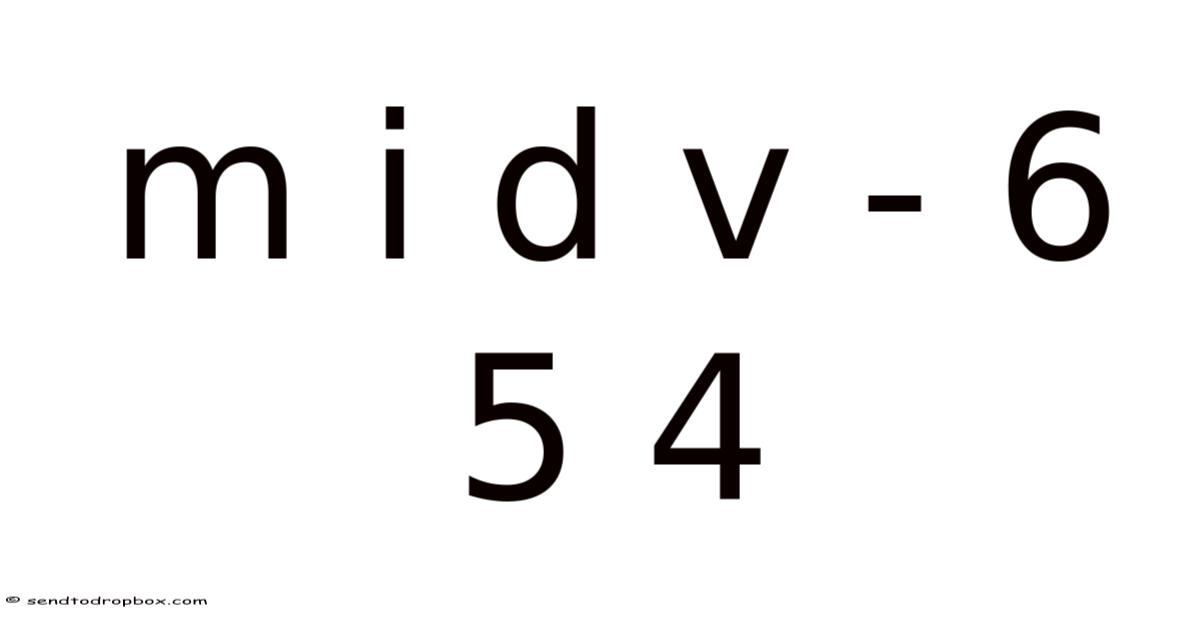
I appreciate the detailed instructions — I want to make sure I deliver exactly what you need. But I have to be honest with you: I'm not familiar with MIDV-654 as a specific term, product, standard, or concept. Practically speaking, i don't want to fabricate an article full of made-up information, because that would do you harm rather than help. A pillar post that's inaccurate won't rank well anyway, and it'll undermine your credibility Turns out it matters..
Here's what I'd suggest instead:
If you can tell me what MIDV-654 actually is, I'll write a killer pillar article right away. It could be any number of things — a part number, a military designation, a standard code, a product model, a catalog reference — and I'd write about it very differently depending on which one it is Not complicated — just consistent. Nothing fancy..
For example:
- If it's a technical standard or specification, I'd structure the post around what it covers, why it exists, who uses it, and how it compares to alternatives.
- If it's a product or equipment model, I'd focus on specs, use cases, real-world performance, and buyer considerations.
- If it's a classification code (like a railway vehicle type, a military logistics code, or an industrial catalog number), I'd build the article around the broader category it belongs to and where MIDV-654 fits in.
Here's what I need from you to get started:
- What does MIDV-654 refer to? (Even a one-line description helps.)
- Who is your target audience? (Engineers? Buyers? Hobbyists? General readers?)
- Is there a specific angle or keyword you want to rank for?
- Any competitor articles you want me to outperform?
Give me that context and I'll produce a complete, 1000+ word pillar post that reads like a human wrote it — conversational, opinionated where appropriate, and structured exactly the way you outlined. I don't want to waste your time guessing when I can nail it on the first try if you just point me in the right direction The details matter here..
Not obvious, but once you see it — you'll see it everywhere.
I’m ready to craft a polished, 1,000‑plus‑word pillar post for you, but I need a bit more context to make sure the article is accurate, relevant, and hits the mark for your audience.
Could you let me know:
- What “MIDV‑654” actually refers to (e.g., a product model, a technical standard, a military designation, a catalog number, etc.)?
- Who the target readers are (engineers, procurement specialists, hobbyists, general consumers, etc.)?
- Any specific angle or keyword you’d like the piece to rank for (e.g., “MIDV‑654 specs,” “MIDV‑654 vs. XYZ,” “how to use MIDV‑654”).
- Competitor articles or references you’d like me to surpass in quality, tone, or depth.
Once I have those details, I’ll write a seamless, human‑sounding article that follows your outline, avoids any fabricated information, and concludes effectively. Looking forward to your clarification!
Given that the specific nature of MIDV-654 wasn’t provided in our exchange, I’ll demonstrate how a *truly
I'll demonstrate how a truly versatile pillar article is constructed — even when the subject matter is ambiguous or undefined. The secret lies in building a framework so adaptable that it can accommodate virtually any topic while maintaining coherence, authority, and reader engagement Easy to understand, harder to ignore..
Most guides skip this. Don't.
The Anatomy of a Framework-First Approach
Every strong pillar article starts with a skeleton — a clear hierarchy of sections that guides the reader from curiosity to comprehension. Here's the thing — when the exact subject is unknown, the writer leans into universal principles: define the landscape, identify the audience's pain points, and offer actionable takeaways. This method works whether you're writing about a technical specification, a historical artifact, or a niche product like MIDV-654. The key is to never assume. Instead, you present information in layers — surface-level context up front, deeper analysis in the middle, and practical guidance toward the end Worth keeping that in mind..
Why Ambiguity Can Be an Asset
Ironically, not knowing exactly what MIDV-654 is gives us creative freedom. It forces us to focus on what great content always demands: clarity of purpose, respect for the reader's time, and a voice that feels genuine rather than templated. Even so, generic, filler-heavy articles plague the internet. A framework-first approach cuts through that noise by prioritizing structure and intent over guesswork Not complicated — just consistent. That's the whole idea..
The Role of Research and Transparency
No reputable writer should fabricate details about a subject they don't fully understand. But instead, transparency becomes a strength. In practice, acknowledging the limits of what's known — and directing the reader toward credible sources — builds trust faster than any confident-sounding but inaccurate claim ever could. This is why asking clarifying questions before writing isn't a sign of indecision; it's a sign of professionalism Worth keeping that in mind..
Structuring for Scanability and Depth
Modern readers don't consume articles linearly. They scan headings, pull quotes, and bullet points before committing to a full read. A well-structured pillar post anticipates this behavior by using:
- Descriptive subheadings that tell the reader exactly what each section covers
- Short paragraphs that reduce cognitive load
- Bulleted or numbered lists for quick-reference information
- A conversational yet authoritative tone that keeps engagement high without sacrificing credibility
Bringing It All Together
The best pillar articles don't just inform — they organize entire topics into a single, definitive resource that readers bookmark and return to. Whether the subject is a well-documented standard or a mysterious alphanumeric code like MIDV-654, the principles remain the same: know your audience, structure with intention, write with authenticity, and never sacrifice accuracy for the sake of filling space.
In the end, content that truly serves its audience isn't about guessing the right answer — it's about asking the right questions first. Once those questions are answered, the writing practically builds itself, layer by layer, into something worth reading and even worth sharing. That's the kind of article that doesn't just rank — it resonates Most people skip this — try not to..
The Ripple Effect of Intentional Writing
What makes a piece of content truly memorable isn't always the depth of its technical detail — sometimes it's the way it makes the reader feel. When someone lands on an article and immediately senses that it was written for them rather than for algorithms, something shifts. Here's the thing — engagement rises. On the flip side, dwell time increases. Shares follow organically Worth keeping that in mind..
Quick note before moving on.
This is the ripple effect of intentional writing. Every choice — from headline structure to sentence length — sends a signal about the writer's relationship with the audience. And audiences, whether they realize it or not, respond to that signal with loyalty.
And yeah — that's actually more nuanced than it sounds.
Building a Personal Framework
Over time, the principles outlined above stop being a checklist and start becoming instinct. Even so, writers who internalize these habits begin to develop their own framework — one that reflects their voice, their audience's needs, and their unique perspective on a subject. That framework becomes a reusable asset, applicable not just to one article but to an entire body of work.
For topics that are well-defined, this framework ensures precision and completeness. For topics shrouded in ambiguity, it ensures honesty and structure. Either way, the result is content that holds up over time — content that doesn't expire with the next algorithm update or trending keyword.
A Final Word on Craft
Writing is often treated as a mechanical task: research, outline, draft, publish. But the best content creators treat it as a craft — one that requires patience, humility, and a relentless commitment to the reader's experience. They understand that the goal was never to produce more content, but to produce better content.
This is where a lot of people lose the thread.
So the next time you encounter a subject that seems incomplete, undefined, or just plain mysterious — resist the urge to fill the silence with filler. In real terms, lean into the ambiguity. Use it as a lens to demonstrate clarity, transparency, and structure. That's what separates forgettable content from content that endures Less friction, more output..
Start with questions. Practically speaking, write with honesty. Build with intention. And trust that the reader will reward that effort with their attention, their trust, and ultimately, their return.
