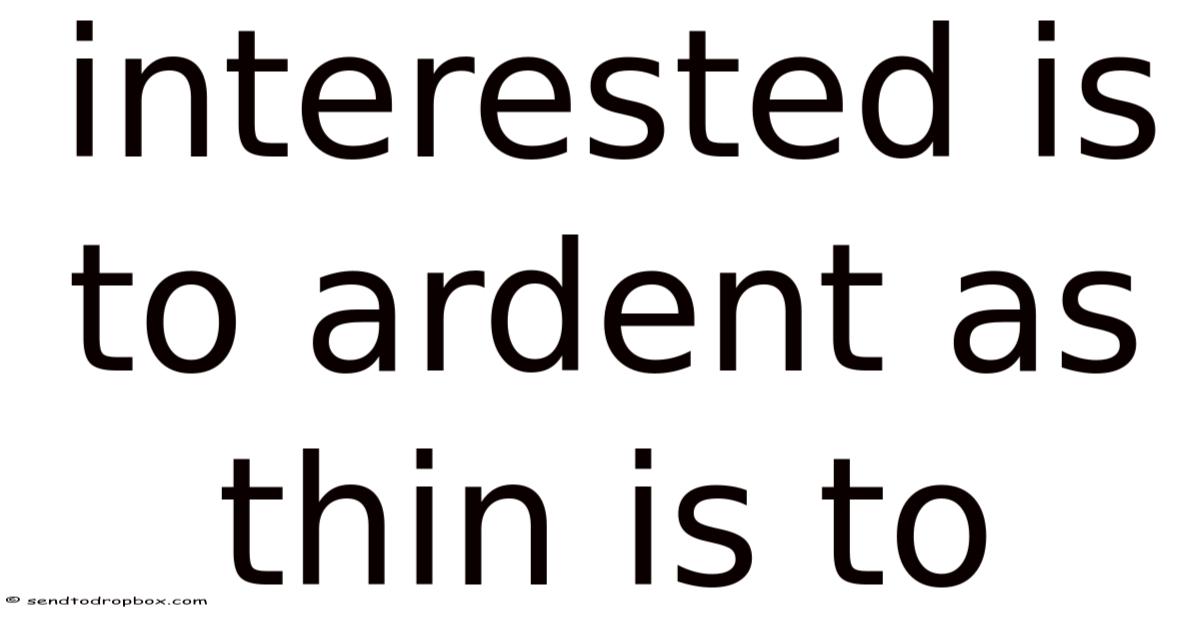
You're staring at a practice test. The question reads: interested is to ardent as thin is to ______
Your palm sweats a little. But the second pair? thin. You know what "interested" means. You know "ardent" means intense, passionate, burning. Here's the thing — "Thin" is... What's the version of thin that matches the jump from interested to ardent?
This is where most people freeze. Think about it: not because they don't know words. Because they don't see the relationship.
What Is a Word Analogy
A word analogy isn't a vocabulary test. It's a logic test wearing a vocabulary costume.
The format is always A : B :: C : D. That said, read it as "A is to B as C is to D. Now, " Your job isn't to define the words. Your job is to identify the precise relationship between the first pair, then find the answer choice that creates the exact same relationship in the second pair.
That's it. That's the whole game.
But test writers know you'll try to shortcut it. They'll give you synonyms, antonyms, part-to-whole, cause-and-effect, degree-of-intensity, tool-to-user, and a dozen other relationship types — all mixed together. The wrong answers? They're designed to trap the most common shortcuts.
The Relationship Types You'll Actually See
Degree of intensity is one of the big ones. But that's what interested : ardent is. Practically speaking, interested is mild. Ardent is the same quality, cranked to eleven.
- warm : scorching
- annoyed : furious
- damp : soaked
- thin : emaciated
Wait. Thin : emaciated. That's our answer.
But let's not jump ahead. The point is: if you can name the relationship, you've already won half the battle.
Why Analogies Matter (Beyond the Test)
You're not studying analogies to ace the GRE or the Miller Analogies Test. Which means well, maybe you are. But the skill transfers.
Legal reasoning runs on analogical thinking. This case is to that precedent as my client's situation is to...
Medical diagnosis works the same way. These symptoms are to that condition as the patient's presentation is to...
Even everyday decisions: *The last time I ignored this feeling, it went badly. This feels similar. So...
Analogical reasoning is how experts think. It's pattern recognition at scale. The test version is just the gym where you build the muscle.
How to Solve Any Analogy — Step by Step
1. Build a Bridge Sentence
Don't just stare at the words. Make a sentence that captures the relationship precisely.
Bad bridge: "Interested is like ardent.In practice, " (Too vague. Synonyms? Antonyms? Degree?
Better bridge: "Ardent is the extreme degree of interested."
Best bridge: "To be ardent is to be interested to an extreme, almost obsessive degree."
The bridge must be specific enough that only the correct answer fits the second pair That's the whole idea..
2. Apply the Bridge to the Second Pair
Now plug in C and test each answer choice.
"To be ______ is to be thin to an extreme, almost dangerous degree."
- slender? No. That's just a synonym. Same degree.
- skinny? Colloquial synonym. Still same degree.
- emaciated? Yes. Extreme thinness from starvation or illness. Dangerous degree.
- lean? Athletic thin. Not extreme in a negative sense.
- narrow? Wrong category entirely. That's width, not body composition.
The bridge eliminates four choices in seconds And that's really what it comes down to..
3. Watch for Part-of-Speech Traps
Interested and ardent are both adjectives. Thin is an adjective. The answer must be an adjective.
If the first pair was interest : ardor (noun : noun), and the second started with thinness (noun), you'd need a noun answer. Emaciation Worth keeping that in mind. Which is the point..
Test writers love slipping in a different part of speech. Don't fall for it Most people skip this — try not to..
4. Check Directionality
Hot : cold is antonym. Cold : hot is also antonym. Direction doesn't matter for symmetric relationships That's the part that actually makes a difference. That alone is useful..
But cause : effect is directional. Spark : fire works. Fire : spark doesn't — fire doesn't cause spark in the same way.
Tool : user is directional. Scalpel : surgeon. Not surgeon : scalpel.
Degree relationships are usually directional. Mild : extreme works. Extreme : mild describes the same relationship but reversed. The bridge sentence must preserve direction But it adds up..
"Ardent is the extreme version of interested" ≠ "Interested is the mild version of ardent." Both true, but only the first matches the A:B order Worth knowing..
5. Eliminate, Don't Select
Most people scan for the right answer. Experts scan for wrong answers and cross them off.
- Wrong relationship type? Cross it.
- Wrong part of speech? Cross it.
- Wrong direction? Cross it.
- Too strong/weak? Cross it.
- Only one left? That's your answer.
This is faster and more accurate. Now, you're not looking for a needle in a haystack. You're burning the haystack And it works..
Common Mistakes / What Most People Get Wrong
Mistake 1: Treating It Like a Synonym Test
Happy : joyful :: sad : ______
If you pick melancholy, you fell for the synonym trap. The answer must be stronger than sad. In practice, the relationship isn't "synonym. And " It's "degree of intensity. Grief-stricken. " Joyful is stronger than happy. On the flip side, Despondent. Inconsolable The details matter here. That alone is useful..
Synonyms are the most common wrong answer choice for degree questions. They're there to catch you on autopilot.
Mistake 2: Ignoring Connotation
Thin : emaciated carries negative connotation. Thin : slender carries positive or neutral Most people skip this — try not to. No workaround needed..
Interested : ardent — ardent can be positive (ardent supporter) or slightly obsessive (ardent fanatic). But it's intense.
If the first pair has a negative connotation shift, the second pair must match. Curious : nosy :: thin : ______ — now you need a negative extreme. In practice, Emaciated works. Svelte doesn't.
Mistake 3: Overthinking Obscure Words
You don't need to know every word. You need to know the relationship.
If the first pair is perspicacious : insightful and you don't know perspicacious, but you recognize insightful as a positive intellectual trait... and the second pair starts with loquacious... and one answer is talkative.. Not complicated — just consistent..
This approach saves time and mental energy. By practicing this method, you’ll become more efficient and confident. The test doesn’t require you to know every word; it requires you to know how words relate. When you encounter a new word, ask: what is the relationship between the two given words? Also, instead of memorizing definitions, focus on the pattern. Practically speaking, then find the pair that matches that relationship. The key is to trust your intuition and let the relationships guide you, not the obscure definitions.
Simply put, mastering these techniques transforms a difficult vocabulary test into a manageable puzzle. By checking directionality, eliminating wrong answers, and avoiding common mistakes, you can improve your scores and, more importantly, expand your vocabulary. That's why remember: the goal is to understand, not to memorize. So read, analyze, and enjoy the process of discovering how words connect That's the part that actually makes a difference. Worth knowing..
This approach also helps you avoid another common pitfall: misidentifying the relationship type altogether. To give you an idea, consider book : library versus word : ______. Some test-takers might assume it's asking for a synonym (book : library :: word : sentence), but the real relationship is "part to whole.Even so, " A book is a part of a library, so a word is a part of a sentence. Recognizing this distinction can save you from choosing an answer that sounds right but misses the mark That's the whole idea..
Another frequent error is assuming that all analogies follow a logical or predictable pattern. And while many do, some rely on cultural knowledge or less obvious associations. Think about it: in these cases, your best strategy is to apply the elimination method described earlier. Even if you’re unsure of the exact relationship, crossing out clearly wrong answers will often leave you with the correct choice.
Additionally, many students waste time trying to recall the precise definition of every word they encounter. The test doesn’t require you to know every word; it requires you to know how words relate. Then find the pair that matches that relationship. Instead of memorizing definitions, focus on the relationship. By practicing this method, you’ll become more efficient and confident. Even so, when you encounter a new word, ask: what is the relationship between the two given words? Which means this is unnecessary and inefficient. The key is to trust your intuition and let the relationships guide you, not the obscure definitions.
The short version: mastering these techniques transforms a difficult vocabulary test into a manageable puzzle. By checking directionality, eliminating wrong answers, and avoiding common mistakes, you can improve your scores and, more importantly, expand your vocabulary. Remember: the goal is to understand, not to memorize. So read, analyze, and enjoy the process of discovering how words connect.
