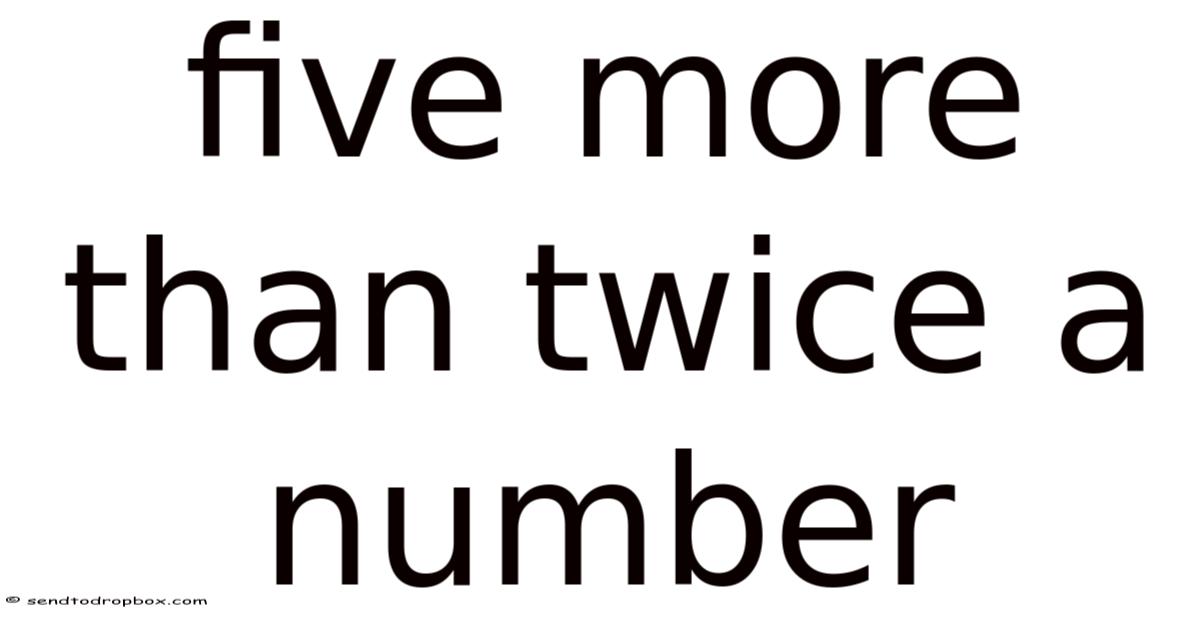
Ever stared at a math word problem and felt that knot in your stomach? Think about it: you know the feeling—when the sentence says “five more than twice a number” and your brain starts spinning. That's why why does this phrase trip us up? Because most people skip the translation step and jump straight to solving, only to realize they’ve misread the whole thing. Let’s break down exactly what “five more than twice a number” really means and why mastering it can save you from those frustrating errors Most people skip this — try not to. Turns out it matters..
What Is Five More Than Twice a Number
When someone says “five more than twice a number,” they’re describing a simple algebraic expression. In real terms, in plain talk, you take an unknown quantity—let’s call it x—double it, and then add five. On top of that, the result is 2x + 5. On the flip side, that’s it. Nothing fancy, just a linear expression that shows up in everything from basic algebra to real‑world budgeting.
You'll probably want to bookmark this section.
Breaking It Down
Think of it like a recipe. First you twice the ingredient (2 × x). Then you add five more units. The order matters: you can’t add five before you double, because “more than” tells you the addition comes after the multiplication. Think about it: in math, that’s why we write 2x + 5, not 2(x + 5). The parentheses would change everything.
Real‑World Examples
Imagine you have a weekly allowance of x dollars. Your parent says you get twice that amount plus an extra five dollars for doing extra chores. Your total weekly cash becomes 2x + 5. That's why or picture a gym membership that costs twice the price of a movie ticket, with a $5 signup fee. The formula pops up everywhere you combine a doubled value with an additional fixed amount.
Why It Matters
Understanding this expression isn’t just about passing algebra class. It’s a building block for more complex math, and it shows up in everyday decision‑making. When you can translate “five more than twice a number” into 2x + 5, you gain the ability to:
- Predict outcomes before they happen.
- Compare different scenarios side by side.
- Spot errors in financial plans or data analysis.
Honestly, this is the part most guides get wrong—they jump straight to solving without explaining the translation. Let’s fix that.
How It Works
Translating Word Problems
The first step is always to identify the unknown. Call it x. Then look for keywords:
- “Twice” → multiply by 2.
- “More than” → addition after the multiplication.
So “twice a number” becomes 2x. Adding five more yields 2x + 5. Keep the order in mind; “more than” signals that the addition comes after the doubling That alone is useful..
Solving for the Unknown
If the problem gives you a result, you can solve for x. Take this: “Five more than twice a number equals 17.” Write it as:
2x + 5 = 17
Subtract 5 from both sides:
2x = 12
Divide by 2:
x = 6
That means the original number was 6. Plus, the steps are simple, but skipping any one of them often leads to mistakes. That’s why practicing the translation first is worth the extra minute.
Graphing the Expression
Because 2x + 5 is a linear expression, you can plot it on a coordinate plane. The slope is 2 (the coefficient of x), and the y‑intercept is 5 (the constant term). Plotting a few points—say, when x = 0 you get y = 5; when x = 2 you get y = 9—draws a straight line that rises two units for every one unit to the right. This visual helps you see how changes in x affect the total, which is handy for everything from budgeting to physics That's the part that actually makes a difference..
Using It in Larger Problems
You’ll often see “five more than twice a number” combined with other expressions. For instance:
-
“Three times the sum of five more than twice a number and four.”
→ 3 × [(2x + 5) + 4] -
“Subtract twice a number from five more than twice a number.”
→ (2x + 5) − 2x
In both cases, the core piece (2x + 5) stays the same, and you just apply the surrounding operations. Recognizing that core helps you avoid getting lost in parentheses It's one of those things that adds up..
Common Mistakes
Mixing Up Order
A frequent slip is reversing the operations. So that’s a classic error. Some write (x + 5) × 2, thinking “five more than twice a number” means add first, then double. Remember: “more than” tells you the addition follows the multiplication Worth keeping that in mind..
Forgetting the “More Than”
If you read “twice a number” and stop there,
If you read “twice a number” and stop there, you’re missing the critical addition of five that fundamentally changes the equation. This oversight is common, especially when the phrase is embedded in more complex problems. To give you an idea, someone might misinterpret “five more than twice a number” as simply 2x, ignoring the “more than” clause. So this leads to incorrect solutions in scenarios where precision matters, like budgeting or engineering calculations. The key is to treat the entire phrase as a single unit—2x + 5—rather than breaking it into isolated parts.
Mastering this translation isn’t just about memorizing formulas; it’s about building a habit of careful reading and logical structuring. Because of that, the more you practice identifying and translating these expressions, the more intuitive it becomes. Over time, you’ll start recognizing patterns in word problems, allowing you to approach them with confidence rather than hesitation.
So, to summarize, the ability to convert phrases like “five more than twice a number” into mathematical expressions is a foundational skill that bridges language and logic. It empowers you to manage real-world problems with clarity, avoid costly errors, and think critically about abstract concepts. Also, while it may seem like a small step, this skill has far-reaching implications, from everyday decisions to advanced academic or professional challenges. By investing time in understanding and practicing these translations, you’re not just solving equations—you’re equipping yourself with a toolset that enhances your analytical thinking for life Simple, but easy to overlook. That's the whole idea..
So, to summarize, the ability to convert phrases like “five more than twice a number” into mathematical expressions is a foundational skill that bridges language and logic. It empowers you to deal with real-world problems with clarity, avoid costly errors, and think critically about abstract concepts. Practically speaking, by investing time in understanding and practicing these translations, you’re not just solving equations—you’re equipping yourself with a toolset that enhances your analytical thinking for life. While it may seem like a small step, this skill has far-reaching implications, from everyday decisions to advanced academic or professional challenges. Whether you’re balancing a budget, designing a system, or unraveling the mysteries of physics, this skill ensures you can turn ambiguous language into precise, actionable mathematics. The journey from words to numbers may feel daunting at first, but with practice, it becomes second nature—a quiet yet powerful testament to the beauty of structured reasoning in an unpredictable world.
Some disagree here. Fair enough.
Expanding on this foundation opens doors to a richer understanding of how language and mathematics intertwine in everyday contexts. This same process applies to more abstract problems, such as determining the distance a projectile travels under gravity, where phrases like “the square of the initial velocity minus twice the product of gravity and time” become the expression v² − 2 g t. Consider the simple act of budgeting: when you hear “three times the monthly savings plus a fixed bonus of $200,” the phrase translates directly into the algebraic form 3 s + 200, where s represents the unknown savings amount. That's why by systematically breaking down each component—identifying the multiplier, the additive constant, and any implied operations—you can construct a reliable equation that models the financial scenario with precision. Recognizing these patterns not only sharpens problem‑solving skills but also cultivates a mindset that seeks clarity amid complexity Practical, not theoretical..
Teaching and learning this translation skill benefits greatly from deliberate practice and feedback. And working through such puzzles encourages students to annotate the text, highlight key relational words (“twice,” “minus,” “equal to”), and then systematically convert each highlighted phrase into its mathematical counterpart. Which means for instance, a problem might state, “If a container holds twice as many marbles as another container, and after removing five marbles from the first container the total number of marbles left is equal to the original count in the second container,” which translates to 2 x − 5 = y and x + y = total. That's why one effective strategy is to present learners with a series of increasingly layered word problems, each demanding a deeper layer of interpretation. Peer discussion further reinforces comprehension; explaining one’s reasoning aloud often reveals hidden assumptions or gaps in understanding that a solitary study session might miss.
Technology also plays a supportive role in mastering these translations. Now, interactive platforms that generate random word problems and provide instant visual feedback can accelerate the learning curve. Visual aids—such as flowcharts that map phrases to operations (e.g.In practice, , “more than” → addition, “twice” → multiplication) or color‑coded symbols that denote variables—help solidify the connection between linguistic cues and mathematical symbols. Beyond that, adaptive learning algorithms can identify specific stumbling blocks, such as misinterpreting “less than” versus “more than,” and tailor subsequent exercises to address those weaknesses, ensuring a personalized and efficient learning trajectory Simple, but easy to overlook..
In the long run, the journey from words to numbers is more than a mechanical exercise; it is a gateway to disciplined thinking that transcends the classroom. But by consistently practicing the translation of everyday language into precise mathematical expressions, individuals cultivate an ability to dissect problems, isolate relevant information, and construct solutions with confidence. This skill becomes a quiet yet powerful ally in a world saturated with data and ambiguity, enabling clearer communication, smarter decision‑making, and a deeper appreciation for the hidden order within the seemingly chaotic flow of daily life. Embracing this practice equips you not only to solve equations but also to figure out the complexities of the real world with a sharper, more analytical lens The details matter here. Turns out it matters..
