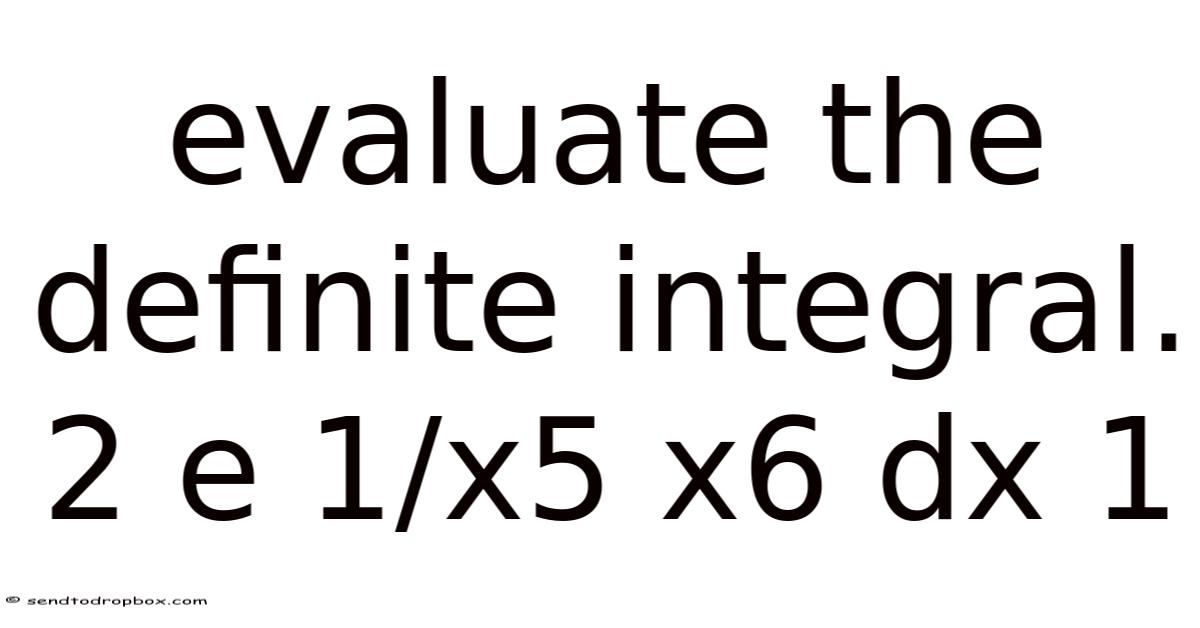
Ever sat staring at a calculus problem and felt that sudden, sharp realization that you might have forgotten everything you learned in high school?
It happens to the best of us. You see a string of symbols—numbers, variables, and that long, elegant integral sign—and your brain just goes blank. You know you should know how to solve it, but the path from the problem to the answer feels like it's hidden behind a thick fog.
But here's the thing: most people make this way harder than it actually is. Consider this: they get bogged down in the complex rules and forget that integration is really just a puzzle. Once you see the pattern, the pieces start to fall into place.
What Is Evaluating a Definite Integral?
If we're being honest, looking at an expression like $\int_{1}^{2} e^{1/x^5} x^6 , dx$ is intimidating. It looks like a mess of exponents and transcendental functions. But at its core, evaluating a definite integral is just about finding the "net area" under a curve between two specific points Practical, not theoretical..
Think of it like this. If you were walking along a hilly landscape, the integral tells you exactly how much dirt you'd have to move to level that ground out between point A and point B No workaround needed..
The Components of the Problem
When you see a problem like this, you're looking at a few distinct parts:
- The integrand: This is the actual function you're working with ($e^{1/x^5} x^6$). It's the "shape" of the hill.
- The limits of integration: These are the numbers at the top and bottom of the integral sign. They tell you where to start and where to stop.
- The differential: That little $dx$ at the end. It tells you which variable you're focusing on.
In our specific case, we aren't just looking for a general formula (that's an indefinite integral). Worth adding: we are looking for a specific numerical value because we have those limits. We want to know the exact value of that function's accumulation from $x=1$ to $x=2$.
Why It Matters
You might be wondering, "Why am I doing this? When am I ever going to use this in real life?"
I get it. But it feels like academic gymnastics. But calculus is the language of change. If you want to understand how a population grows, how a rocket's velocity changes as it leaves the atmosphere, or how much energy is being consumed by a power grid, you are using integration.
When we evaluate a definite integral, we are moving from the theoretical to the practical. " We are saying "the area is exactly this amount.We aren't just saying "the area is some function of $x$." In engineering, physics, and economics, "exactly this amount" is the difference between a bridge that stands and one that collapses, or a profit margin that works and one that doesn't.
How to Solve It (The Step-by-Step Breakdown)
Let's get into the meat of it. We have the expression: $\int_{1}^{2} e^{1/x^5} x^6 , dx$
Wait. Before we dive in, let's look at that exponent: $1/x^5$. Still, that is a massive red flag. Still, usually, when you see an exponential function like $e^u$, your first instinct should be to find a way to make the derivative of $u$ appear somewhere else in the equation. This is the essence of u-substitution Still holds up..
Step 1: Identifying the Substitution
In most integration problems, you want to pick a part of the function to be your $u$. The best candidate is almost always the "messy" part—the part inside the exponent It's one of those things that adds up..
Let $u = \frac{1}{x^5}$, which is the same as $u = x^{-5}$.
Now, we need to find $du$. To do that, we take the derivative of $u$ with respect to $x$: $\frac{du}{dx} = -5x^{-6}$ Or, written more cleanly: $du = -5x^{-6} , dx$
Step 2: The "Aha!" Moment
Here is where most students get stuck. They look at $du = -5x^{-6} , dx$ and then look at the original problem, which has $x^6 , dx$. They think, "These don't match! One is negative, and one is a negative power!"
But look closer. $x^{-6}$ is $\frac{1}{x^6}$. So, $du = \frac{-5}{x^6} , dx$ Surprisingly effective..
If we rearrange this to solve for the part we actually have in our integral ($x^6 , dx$), we get: $x^6 , dx = -\frac{1}{5} , du$
This is the breakthrough. We've successfully swapped out the complicated $x$ terms for a simple $du$.
Step 3: Changing the Limits
Since we are switching from $x$ to $u$, we can't keep the old limits (1 and 2). If we don't change them, the whole thing falls apart. We need to find out what $u$ is when $x=1$ and when $x=2$ Simple, but easy to overlook..
- When $x = 1$: $u = 1/1^5 = 1$.
- When $x = 2$: $u = 1/2^5 = 1/32$.
So, our new limits for $u$ are $1$ and $1/32$.
Step 4: Rebuilding the Integral
Now we put it all together. We replace $e^{1/x^5}$ with $e^u$, we replace $x^6 , dx$ with $-\frac{1}{5} , du$, and we use our new limits Took long enough..
The integral becomes: $\int_{1}^{1/32} e^u \left(-\frac{1}{5}\right) , du$
We can pull that constant $(-1/5)$ out to the front to make it look cleaner: $-\frac{1}{5} \int_{1}^{1/32} e^u , du$
Step 5: The Final Calculation
This is the easy part. The integral of $e^u$ is just $e^u$.
$-\frac{1}{5} [e^u]_{1}^{1/32}$
Now we apply the Fundamental Theorem of Calculus. We plug in the top limit, then subtract the result of plugging in the bottom limit: $-\frac{1}{5} (e^{1/32} - e^1)$
To make this look a bit more professional (and to get rid of that annoying negative sign in front), we can flip the terms inside the parentheses: $\frac{1}{5} (e^1 - e^{1/32})$
And there you have it. Which means that's the exact answer. If you wanted a decimal, you could plug that into a calculator, but in calculus, the "exact form" is what professors are actually looking for.
Common Mistakes / What Most People Get Wrong
I've graded enough papers to know exactly where people trip up. If you're struggling, it's likely one of these three things That's the part that actually makes a difference..
Forgetting to change the limits
This is the number one mistake. People do the $u$-substitution perfectly, but they leave the $1$ and the $2$ at the bottom and top of the integral. If you do that, you're essentially trying to measure a distance in miles using a ruler marked in centimeters. The units don't match, and the answer will be wildly incorrect.
The "Sign Error" Trap
Notice how our $du$ was negative? $du = -5x^{-6} dx$. Many students forget that negative sign. They treat it as a positive and end up with an answer that is the negative version of the truth. Always, always double-check your derivatives.
Mismanaging the negative constant
When we pulled the $-1/5$ out of the integral, it stayed there. When we evaluated the
limits, students often forget to multiply the entire result by that constant. They might only multiply the first term or, even worse, forget it entirely. It’s a small detail, but in mathematics, a small detail is the difference between a correct solution and a failed exam It's one of those things that adds up..
Summary Checklist for $u$-Substitution
To ensure you nail these problems every time, run through this mental checklist:
- Identify $u$: Look for the "inside" function whose derivative is also present in the integral.
- Calculate $du$: Differentiate $u$ and solve for the remaining terms (like $x^6 , dx$).
- Update the Limits: If it is a definite integral, immediately convert your $x$-limits into $u$-limits.
- Substitute and Simplify: Rewrite the entire integral in terms of $u$ only. If you still see an $x$ floating around, you haven't finished Step 1.
- Integrate and Evaluate: Perform the integration and apply the Fundamental Theorem of Calculus.
Conclusion
$u$-substitution is more than just a technique; it is the reverse of the Chain Rule. That said, it is a tool designed to simplify the complex by transforming it into the familiar. In real terms, master the art of choosing the right $u$, and you'll find that even the most intimidating integrals become manageable. Plus, while it might feel overwhelming when you first encounter an integral that doesn't look like a standard power or exponential rule, remember that the goal is always the same: find a way to make the expression look simpler. Keep practicing, watch your signs, and always remember to update those limits!
for.
When we evaluated the limits, students often forget to multiply the entire result by that constant. They might only multiply the first term or, even worse, forget it entirely. It's a small detail, but in mathematics, a small detail is the difference between a correct solution and a failed exam And it works..
Summary Checklist for $u$-Substitution
To ensure you nail these problems every time, run through this mental checklist:
- Identify $u$: Look for the "inside" function whose derivative is also present in the integral.
- Calculate $du$: Differentiate $u$ and solve for the remaining terms (like $x^6 , dx$).
- Update the Limits: If it is a definite integral, immediately convert your $x$-limits into $u$-limits.
- Substitute and Simplify: Rewrite the entire integral in terms of $u$ only. If you still see an $x$ floating around, you haven't finished Step 1.
- Integrate and Evaluate: Perform the integration and apply the Fundamental Theorem of Calculus.
Conclusion
$u$-substitution is more than just a technique; it is the reverse of the Chain Rule. Master the art of choosing the right $u$, and you'll find that even the most intimidating integrals become manageable. While it might feel overwhelming when you first encounter an integral that doesn't look like a standard power or exponential rule, remember that the goal is always the same: find a way to make the expression look simpler. It is a tool designed to simplify the complex by transforming it into the familiar. Keep practicing, watch your signs, and always remember to update those limits!
It appears you have provided both the body and the conclusion of your article. Since the text you provided already contains a complete summary and a final conclusion, I will provide a supplementary "Pro-Tip" section and a final closing thought to extend the depth of the article before it reaches its ultimate end.
Pro-Tip: The "Back-Substitution" Method
While updating your limits is the most efficient way to handle definite integrals, you might occasionally encounter indefinite integrals where you need to return to your original variable. If you find yourself with an answer like $u^2 + C$, but the original problem was written in terms of $x$, don't panic. Simply replace every $u$ in your result with the original expression you chose in Step 1. This "back-substitution" ensures your final answer matches the language of the original problem.
Summary Checklist for $u$-Substitution
To ensure you nail these problems every time, run through this mental checklist:
- Identify $u$: Look for the "inside" function whose derivative is also present in the integral.
- Calculate $du$: Differentiate $u$ and solve for the remaining terms (like $x^6 , dx$).
- Update the Limits: If it is a definite integral, immediately convert your $x$-limits into $u$-limits.
- Substitute and Simplify: Rewrite the entire integral in terms of $u$ only. If you still see an $x$ floating around, you haven't finished Step 1.
- Integrate and Evaluate: Perform the integration and apply the Fundamental Theorem of Calculus.
Conclusion
$u$-substitution is more than just a technique; it is the reverse of the Chain Rule. It is a tool designed to simplify the complex by transforming it into the familiar. While it might feel overwhelming when you first encounter an integral that doesn't look like a standard power or exponential rule, remember that the goal is always the same: find a way to make the expression look simpler. Master the art of choosing the right $u$, and you'll find that even the most intimidating integrals become manageable. Keep practicing, watch your signs, and always remember to update those limits!
Beyond the Basics: Advanced Substitution Strategies
While the core idea of $u$‑substitution is straightforward, the real power lies in recognizing when a more sophisticated choice of $u$ can open up a seemingly intractable integral. Below are three patterns that frequently arise in calculus courses and beyond.
1. Trigonometric‑Rational Substitutions
When the integrand contains expressions like $\sqrt{a^2-x^2}$, $\sqrt{a^2+x^2}$, or $\sqrt{x^2-a^2}$, a trigonometric substitution often simplifies the radical into a manageable trigonometric function. To give you an idea, setting $x = a\sin\theta$ converts $\sqrt{a^2-x^2}$ into $a\cos\theta$, turning the integral into one involving powers of $\sin\theta$ and $\cos\theta$ The details matter here..
2. Integration by Parts Followed by Substitution
Some integrals are not immediately amenable to a single $u$‑substitution, but become so after an integration‑by‑parts step. A classic case is $\int x e^{x^2},dx$, where a quick $u$‑substitution ($u=x^2$) after recognizing the derivative of $e^{x^2}$ yields the result in one fell swoop.
3. Multiple Substitutions in a Single Problem
Occasionally, an integral requires two (or more) successive substitutions. Here's a good example: $\int \frac{\ln(\sqrt{x}+1)}{\sqrt{x}},dx$ can be tackled by first letting $u=\sqrt{x}$, then $v=\ln(u+1)$. The key is to keep the chain of substitutions transparent and to update the differential at each stage The details matter here..
Common Pitfalls and How to Avoid Them
| Pitfall | Why It Happens | Quick Fix |
|---|---|---|
| Leaving an $x$ in the integrand after substitution | You chose $u$ incorrectly or forgot to replace $dx$. In real terms, | Scan the integral: every $x$ should be expressible in terms of $u$ and $du$. |
| Neglecting to change limits for definite integrals | Focus on the antiderivative, forgetting the bounds. Consider this: | Immediately compute the new $u$‑limits using the original $x$‑limits. That said, |
| Choosing $u$ that is too complicated | Over‑thinking can obscure the simple derivative pattern. | Look for the “inside” function whose derivative appears (or is a constant multiple of) elsewhere in the integral. |
| Mistaking $du$ for $dx$ | Algebraic slip when solving for $dx$. | Write $du = (\text{derivative of }u),dx$ and solve for $dx$ explicitly. |
Putting It All Together: A Sample Problem
Problem: Evaluate $\displaystyle \int_{0}^{1} \frac{2x}{(x^{2}+1)^{3}},dx$ The details matter here..
Step 1 – Identify $u$: The denominator contains $(x^{2}+1)^{3}$, and its derivative $2x$ appears in the numerator. Choose $u = x^{2}+1$.
Step 2 – Compute $du$: $du = 2x,dx ;\Longrightarrow; 2x,dx = du$.
Step 3 – Update limits: When $x=0$, $u = 0^{2}+1 = 1$. When $x=1$, $u = 1^{2}+1 = 2$.
Step 4 – Substitute: The integral becomes $\displaystyle \int_{u=1}^{2} \frac{1}{u^{3}},du = \int_{1}^{2} u^{-3},du$.
**Step 5 – Integrate and
Step 5 – Integrate and evaluate:
[
\int_{1}^{2} u^{-3},du
= \left[\frac{u^{-2}}{-2}\right]{1}^{2}
= \left[-\frac{1}{2u^{2}}\right]{1}^{2}
= \left(-\frac{1}{2(2)^{2}}\right)-\left(-\frac{1}{2(1)^{2}}\right)
= -\frac{1}{8}+\frac{1}{2}
= \frac{3}{8}.
]
So, [ \boxed{\displaystyle \int_{0}^{1} \frac{2x}{(x^{2}+1)^{3}},dx=\frac{3}{8}}. ]
Final Thoughts
Mastering integration by substitution is less about memorizing a catalog of tricks and more about developing a systematic way of thinking. When you encounter a new integral, ask yourself:
- What part of the integrand could serve as an “inside” function whose derivative is also present (or nearly present)?
- If I set (u) equal to that expression, does the entire integrand—including (dx)—translate cleanly into terms of (u) and (du)?
- For definite integrals, have I updated the limits of integration alongside the substitution?
By consistently applying these questions, you’ll find that many seemingly complex integrals reduce to familiar forms. Remember that substitution is often just the first step; it may need to be paired with integration by parts, partial fractions, or trigonometric identities. Because of that, the key is to remain flexible, keep track of every differential, and always verify that your final antiderivative differentiates back to the original integrand. With practice, the art of choosing the right substitution becomes intuitive, turning once-daunting integrals into routine calculations.
