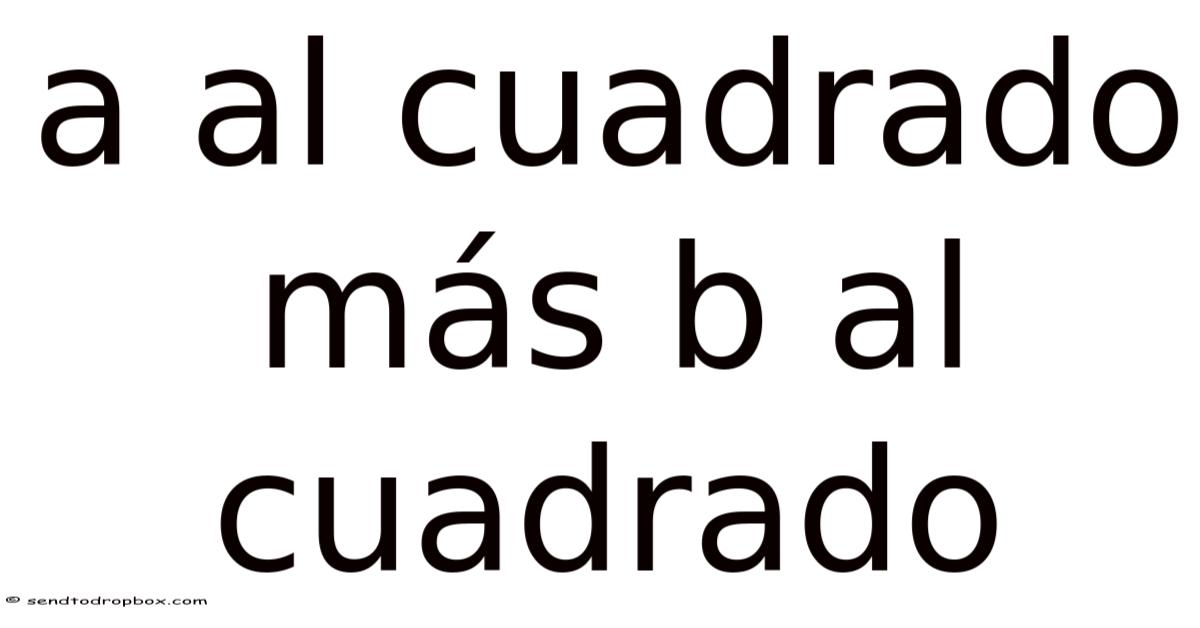
Look, you’ve probably seen the expression “a al cuadrado más b al cuadrado” scribbled on a chalkboard, tucked into a homework sheet, or whispered in a math‑class hallway. Now, it looks simple, but there’s a lot hiding behind those two little squares. Let’s unpack it together, step by step, and see why it shows up everywhere from architecture to video games.
What Is a al cuadrado más b al cuadrado
At its core, the phrase just means take a number a, multiply it by itself, take another number b, multiply it by itself, and then add the two results. Practically speaking, in symbols we write a² + b². Even so, it’s the sum of two squares. Nothing mystical, just basic arithmetic, yet it becomes the backbone of some surprisingly deep ideas Simple, but easy to overlook. That's the whole idea..
The basic idea
If a = 3 and b = 4, then a al cuadrado más b al cuadrado is 3² + 4² = 9 + 16 = 25. ” things get interesting. You could stop there and call it a calculation, but the moment you start asking “what does 25 represent?That number often turns out to be the square of a third value, c, giving us the famous relationship a² + b² = c².
Where you see it
You’ll encounter this sum of squares in geometry when dealing with right triangles, in physics when calculating resultant forces, in statistics when measuring variance, and even in computer graphics when figuring out distances on a screen. It’s one of those quiet workhorses that never asks for applause but keeps the whole show running.
Why It Matters / Why People Care
Understanding why a al cuadrado más b al cuadrado matters isn’t just about passing a test. It’s about recognizing a pattern that repeats in the world around us. When you see the pattern, you can solve problems faster, spot errors sooner, and appreciate the elegance of mathematics Worth knowing..
In geometry
The most famous home for a² + b² is the Pythagorean theorem. In any right‑angled triangle, the square of the length of the hypotenuse (the side opposite the right angle) equals the sum of the squares of the other two sides. That’s not a coincidence; it’s a geometric truth that has been used for thousands of years to build pyramids, manage oceans, and design modern skyscrapers Simple, but easy to overlook..
In everyday math
Beyond triangles, the sum of squares appears when you calculate the distance between two points on a grid. If you move a steps horizontally and b steps vertically, the straight‑line distance is the square root of a² + b². So whether you’re figuring out the shortest route across a city block or checking how far a drone has flown, you’re relying on that same expression.
How It Works (or How to Do It)
Let’s get practical. Knowing the theory is nice, but being able to apply it confidently is what turns a curious learner into a capable problem‑solver.
Breaking down the expression
First, square each number individually. Squaring means multiplying the number by itself. If you’re working with fractions, decimals, or negatives, the rule stays the same: multiply the value by itself. Now, then add the two products together. That’s it—no hidden steps, no tricks.
Visual proof of a² + b² = c²
Worth mentioning: most satisfying ways to see why the formula works is with a simple diagram. Which means the area of the square on the hypotenuse exactly matches the combined area of the squares on the other two sides. Consider this: rearranging those smaller squares to fill the larger one gives a visual “aha! Draw a right triangle, then construct a square on each side. ” moment that sticks better than any abstract proof Not complicated — just consistent..
Calculating with numbers
Suppose you need to find the length of a ladder that will reach a window 12 feet high when the base of the ladder is placed 5 feet from the wall. Even so, here a = 5, b = 12. Now, compute a² + b² = 5² + 12² = 25 + 144 = 169. The ladder length c is the square root of 169, which is 13 feet. You didn’t need a protractor or a fancy tool—just a little arithmetic.
Using it in algebra
The expression also shows up when you expand
Using it in algebra
The expression also shows up when you expand binomials or simplify quadratic equations. To give you an idea, if you’re working with the identity ((a + b)^2 = a^2 + 2ab + b^2), you’ll notice that the squared terms form part of the result. More importantly, when solving systems of equations or optimizing quadratic functions, isolating (a^2 + b^2) can simplify the problem. Suppose you’re given (a^2 + b^2 = 25) and (a + b = 7); substituting or manipulating these equations lets you solve for (a) and (b) without guesswork.
Beyond the Classroom
While textbooks love to box this formula into geometry problems, its reach extends into fields you might not expect Not complicated — just consistent..
Physics and engineering
Engineers use (a^2 + b^2) to calculate resultant forces or velocities. Which means if two perpendicular forces act on an object—one pushing east and another north—the total magnitude of the combined force is the square root of their squares summed together. Pilots and sailors rely on this principle to compute wind corrections or course adjustments, ensuring they stay on track even when battling crosswinds.
Short version: it depends. Long version — keep reading.
Computer graphics
In 2D game development or animation, every pixel’s position is a coordinate pair ((x, y)). To move a character smoothly from point A to point B, the engine calculates the straight-line distance using the same formula. This ensures characters don’t zig-zag across the screen and animations feel natural.
Data science
Statisticians and data scientists use the sum of squares to measure variance or error. When evaluating how well a predictive model fits data, they compute the squared differences between predicted and actual values, summing them to gauge overall accuracy. Minimizing this sum of squares is the core idea behind regression analysis—a cornerstone of machine learning That's the part that actually makes a difference. Surprisingly effective..
Common Pitfalls to Avoid
Even seasoned problem-solvers can slip up. Here’s what to watch for:
- Forgetting to square first: Adding before squaring changes the result entirely. ((a + b)^2 \neq a^2 + b^2) unless (ab = 0).
- **Mixing
up positive and negative signs**: When dealing with negative values, remember that squaring any real number—whether positive or negative—always results in a positive value. A common error is thinking that ((-5)^2) is (-25), when it is actually (25).
- Confusing the sides: In right-angled triangles, always see to it that $c$ represents the hypotenuse (the longest side). If you accidentally plug a leg into the $c$ position, your calculation will be incorrect.
Conclusion
The Pythagorean theorem is far more than a static rule for solving triangles; it is a fundamental building block of mathematical language. In real terms, from the simple task of leaning a ladder against a wall to the complex algorithms that drive modern artificial intelligence, the relationship between $a^2 + b^2 = c^2$ provides a bridge between dimensions. By understanding this principle, you gain a tool that is as useful in a construction site as it is in a high-tech laboratory, proving that sometimes the simplest patterns are the most powerful.
Counterintuitive, but true.
