Ever sat there staring at a math problem that felt more like a riddle than actual math? You know the type. It’s one of those sentences that sounds perfectly normal when someone says it out loud, but the moment you try to write it down on paper, your brain just... stalls.
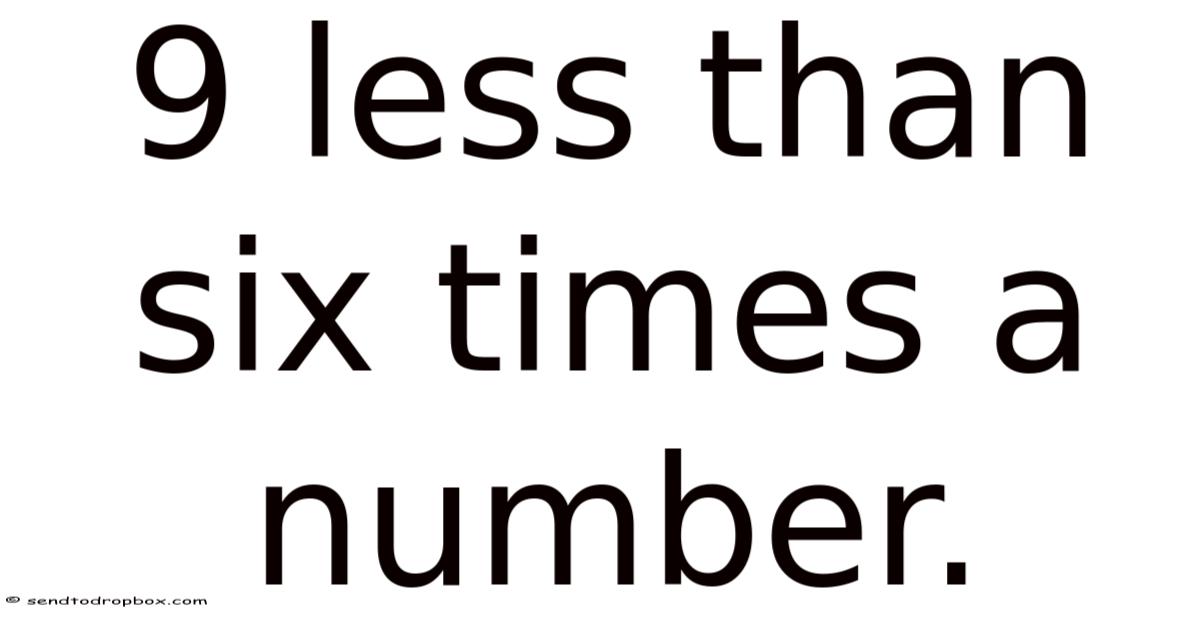
"9 less than six times a number."
It’s a classic. It’s the kind of phrase that shows up in every algebra textbook and trips up almost everyone who encounters it for the first time. But here’s the thing — once you see the pattern, these problems stop being obstacles and start being simple puzzles Still holds up..
What Is 9 Less Than Six Times a Number
If you try to translate this sentence directly from left to right, you’re going to run into a wall. ". Think about it: most people see "9 less than" and immediately want to write "9 -... But that's actually the trap Not complicated — just consistent. Turns out it matters..
In plain English, this phrase is a mathematical instruction telling you to take a specific amount, multiply it by something, and then subtract 9 from that result. It’s not about starting with 9; it’s about ending with 9 being taken away Nothing fancy..
Breaking Down the Components
To make sense of this, we have to look at the two distinct operations happening here.
First, we have "six times a number." In the world of algebra, we don't know what that number is yet. Plus, we call it a variable. Worth adding: usually, we use $x$, but it could be $n$, $y$, or even a little drawing of a star. "Six times a number" simply means $6 \times x$, or more commonly, $6x$ The details matter here. Surprisingly effective..
Second, we have "9 less than." This is the part that trips people up. So the phrase "less than" is a subtraction indicator, but it also acts as a reversal command. It tells you that the 9 isn't the starting point; it's the amount being removed from something else And that's really what it comes down to..
The Role of the Variable
The "number" in this sentence is the heart of the expression. It’s the unknown value that everything else depends on. Because we don't know what it is, we treat it as a placeholder. The entire expression, $6x - 9$, is just a way of describing a relationship. We aren't solving for a specific answer yet; we are just describing a rule.
Why It Matters / Why People Care
You might be thinking, "Why am I spending my time decoding this? I'm not going to be calculating '9 less than six times a number' at the grocery store."
But here's the reality: this isn't actually about the number 9 or the number 6. It’s about translation.
Algebra is essentially a foreign language. It’s a way of taking messy, real-world situations and turning them into precise, logical symbols. If you can master the ability to translate "9 less than six times a number" into $6x - 9$, you have mastered the fundamental skill of mathematical literacy Turns out it matters..
Real-World Context
Think about how this works in actual life. Imagine you are running a small business selling custom t-shirts. You have a base setup fee of $9, and then you charge $6 for every shirt you sell.
If you want to know your total profit, you'd take the number of shirts ($x$), multiply it by 6, and then subtract that initial $9 cost. The expression $6x - 9$ perfectly describes your profit margin.
When people struggle with algebra, it’s usually not because they can't do the math—it's because they can't translate the world into math. Once you get this down, you start seeing the underlying structure of everything from interest rates to engineering specs.
How It Works (How to Do It)
Let's get into the mechanics. If you want to solve these types of problems every single time without having to think too hard, you need a system. Consider this: you can't rely on "vibes. " You need a step-by-step method to strip the words away and reveal the math underneath.
Counterintuitive, but true.
Step 1: Identify the Unknown
Every algebraic expression has a "mystery guest." In this case, it's "a number." Before you do anything else, assign a letter to that mystery.
- "A number" $\rightarrow x$
Step 2: Isolate the Operations
Now, look for the words that tell you what to do.
- "Times" $\rightarrow$ Multiplication ($\cdot$ or $\times$)
- "Less than" $\rightarrow$ Subtraction ($-$)
Step 3: The "Reversal" Rule
At its core, the most important part. This is where most students lose points on tests.
When you see the phrase "less than," it means you are subtracting something from something else. It flips the order. If I say, "I have 5 dollars less than you," I don't write $5 - y$. I write $y - 5$. I have to know how much you have first, and then I subtract 5.
It sounds simple, but the gap is usually here.
So, for "9 less than six times a number," we take the "six times a number" ($6x$) and we subtract the 9 from it.
The final result: $6x - 9$ That's the part that actually makes a difference..
Step 4: Verification
Always check your work by plugging in a simple number. Let's say the "number" is 10 And it works..
- The word version: Six times 10 is 60. 9 less than 60 is 51.
- The math version: $6(10) - 9 = 60 - 9 = 51$.
They match. You've got it right The details matter here..
Common Mistakes / What Most People Get Wrong
I've been looking at math problems for a long time, and I see the same three mistakes over and over again. If you avoid these, you're already ahead of 90% of the people sitting in a classroom Not complicated — just consistent..
The Order Error
As I mentioned earlier, the biggest mistake is writing $9 - 6x$. " is a command to subtract 9 from the following amount. Plus, people see the "9" first and the "6" second, so they write them in that order. But "9 less than...If you write $9 - 6x$, you haven't solved the problem; you've actually created the exact opposite of what was asked.
Confusing "Less Than" with "Less"
This is a subtle one. There is a massive difference between "9 less than $x${content}quot; and "9 is less than $x$."
- "9 less than $x${content}quot; is an expression ($x - 9$). It's a fragment. It's not a complete thought.
- "9 is less than $x${content}quot; is an inequality ($9 < x$). It's a statement that tells you something about the relationship between two values.
If you see the word "is," you aren't just looking for an expression; you're looking for a comparison.
Misinterpreting "Times"
Sometimes people get confused when the multiplier is a fraction or a negative number. But the rule remains the same. Whether it's "six times a number" or "negative three times a number," you always attach that coefficient directly to your variable.
This changes depending on context. Keep that in mind Most people skip this — try not to..
Practical Tips / What Actually Works
If you're studying for a test or just trying to sharpen your brain, here is how you actually get good at this That's the whole idea..
-
Read it out loud. Sometimes, hearing the cadence of the sentence helps your brain realize that the "9" is an afterthought, not the starting point.
-
Draw it out. If you're stuck, draw a box for the "number" and then draw six boxes next to it. Then, imagine taking 9 units away from that pile. It sounds childish, but it works.
-
Build a "Translation Cheat Sheet."
- "Sum of" $\rightarrow$ $+$
- "Difference of" $\rightarrow$ $-$
- "Product of" $\rightarrow$ $\times$
- "Quotient of" $\rightarrow$ $\div$
- "Is" $\rightarrow$ $=$
-
"More than" / "Less than" $\rightarrow$ Flip the order. (This is the single most important rule on the sheet. Tape it to your monitor.)
Practice Makes Permanent
Don't just read these examples—cover the answers and force your hand to write the algebra. Here are three to start with right now:
-
"Five more than twice a number."
Target: $2x + 5$ (Not $5 + 2x$—order matters for subtraction, but addition is commutative. Still, standard form puts the variable first.) -
"The quotient of a number and 4, decreased by 7."
Target: $\frac{x}{4} - 7$ (Identify the main operation first: "quotient." Build that fraction. Then apply the "decreased by.") -
"Three times the sum of a number and 8."
Target: $3(x + 8)$ (The word "sum" triggers parentheses. Without them, $3x + 8$ means something completely different: "8 more than three times a number.")
Answers:
- $2x + 5$
- $\frac{x}{4} - 7$
- $3(x + 8)$
Conclusion
Translating words into algebra isn't a magic trick reserved for "math people." It is a strict, logical grammar. English is ambiguous and flowery; algebra is precise and structural. The friction you feel comes from trying to map a messy, linear sentence onto a hierarchical, operational tree.
The phrase "9 less than six times a number" trips people up because English puts the subtrahend (9) before the minuend ($6x$). Algebra demands the reverse. Once you accept that "less than" is a rear-view mirror instruction—telling you to look backward at what you just built and subtract from that—the confusion evaporates.
Stop hunting for keywords in isolation. Start reading for structure. Find the main verb ("is," "equals," "gives you"), identify the two phrases it connects, and translate those phrases from the inside out.
Do ten practice problems today. Do five more tomorrow. The pattern recognition will kick in, and soon you won't be translating anymore—you'll just be reading.
