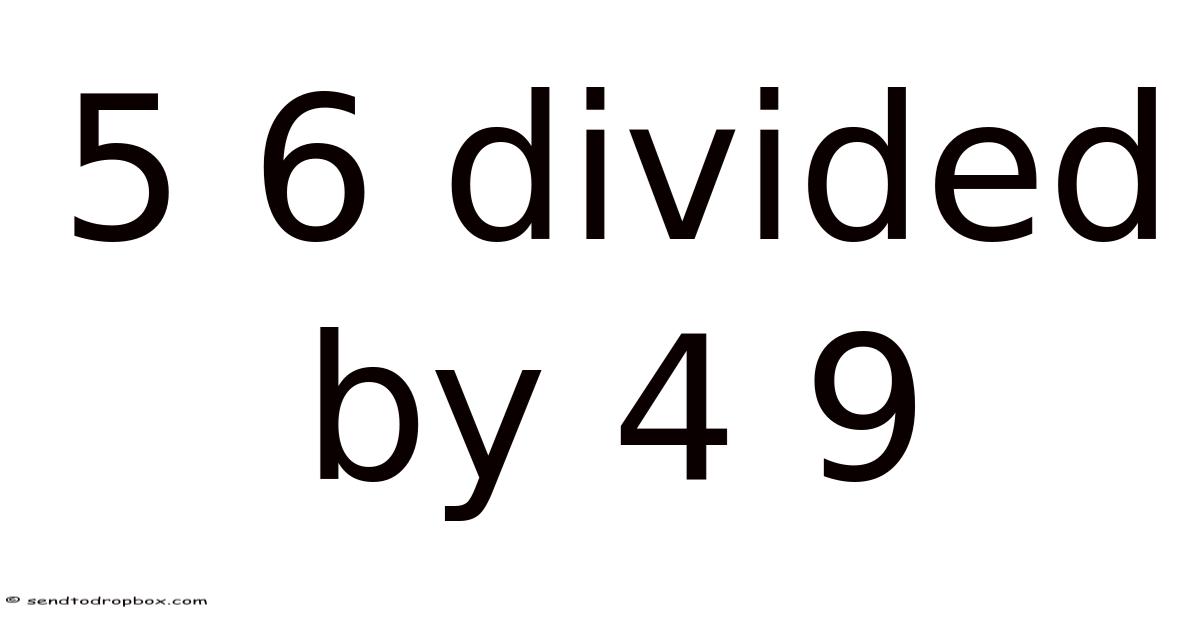
Ever stared at a math problem and felt like you were staring at ancient hieroglyphics? But it’s actually a simple operation once you know the trick. Take a look at 5 6 divided by 4 9 and you might think it’s a secret code. In this post we’ll unpack the whole thing, step by step, in a way that feels more like a conversation than a lecture. You’re not alone. Grab a coffee, settle in, and let’s get into it.
What Is 5 6 divided by 4 9?
Breaking down the notation
First off, the expression 5 6 divided by 4 9 isn’t some mysterious shorthand. It’s just a way of writing two fractions next to each other with a division sign in between. Still, in proper math language you’d read it as “five sixths divided by four ninths. ” The spaces are just placeholders that sometimes appear when a keyboard can’t handle the slash. So when you see 5 6 ÷ 4 9, think of it as (5/6) ÷ (4/9). That’s the core idea Still holds up..
The math behind the symbols
Fractions are a way to show parts of a whole. The top number (numerator) tells you how many parts you have
The math behind the symbols is all about how we turn a “division” into something we can actually compute. When we’re dividing one fraction by another, the rule is simple: you flip the second fraction and multiply.
Turning a division into a multiplication
Take your two fractions:
[ \frac{5}{6} \quad \text{and} \quad \frac{4}{9}. ]
Dividing by (\frac{4}{9}) is the same as multiplying by its reciprocal, (\frac{9}{4}):
[ \frac{5}{6} \div \frac{4}{9} ;=; \frac{5}{6} \times \frac{9}{4}. ]
That “reciprocal” trick works for every fraction: (\frac{a}{b} \div \frac{c}{d} = \frac{a}{b} \times \frac{d}{c}). Think of it as swapping the numerator and denominator of the divisor and then treating the whole thing like a regular multiplication problem.
Multiplying the fractions
Now we just multiply the numerators together and the denominators together:
[ \frac{5 \times 9}{6 \times 4} ;=; \frac{45}{24}. ]
You might notice that (45) and (24) share a common factor—(3). Simplifying by dividing both by (3) gives:
[ \frac{45 \div 3}{24 \div 3} ;=; \frac{15}{8}. ]
So the exact answer is (\boxed{\dfrac{15}{8}}) Small thing, real impact..
A quick sanity check
A fraction larger than (1) means we’re dealing with a value that’s more than a whole. In practice, because five‑sixths is a larger portion than four‑ninths, the answer should be more than one. Here's the thing — that makes sense: you’re taking five‑sixths and asking how many times four‑ninths fit into it. Since (15) is greater than (8), (\frac{15}{8}) is indeed larger than (1). The result, (\frac{15}{8}) (or (1\frac{7}{8}) as a mixed number), confirms that intuition Easy to understand, harder to ignore..
Real talk — this step gets skipped all the time.
A real‑world analogy
Imagine you have a chocolate bar that’s cut into six equal pieces. You eat five of those pieces, leaving you with (\frac{5}{6}) of the bar. Now suppose a friend offers you a portion that’s (\frac{4}{9}) of a whole bar. How many of those friend‑sized portions could you fit into what you’re left with?
You set up the same division: (\frac{5}{6} \div \frac{4}{9}). So the answer, (\frac{15}{8}), tells you you can fit one full portion plus a little more (specifically, (\frac{7}{8}) of another). Basically, you’re able to “buy” the friend’s portion 1.875 times with the chocolate you have remaining Worth keeping that in mind. Simple as that..
Quick tips for future fraction‑division problems
- Flip and multiply – always turn the divisor into its reciprocal before multiplying.
- Cross‑cancel early – if you can cancel a factor between a numerator and a denominator before multiplying, you’ll keep the numbers smaller and the arithmetic easier.
[ \frac{5}{6} \times \frac{9}{4} \quad\text{(cross‑cancel 3)}\quad \frac{5}{2} \times \frac{3}{4} = \frac{15}{8}. ] - Check the size – if the result seems bigger than the dividend, that’s a good sign you’re on the right track.
Conclusion
Dividing fractions might look intimidating at first, but once you remember the reciprocal trick, it’s just a natural extension of multiplication. By flipping the second fraction, multiplying, and simplifying, you transform a seemingly cryptic expression into a clear, manageable calculation. Whether you’re slicing pizza, measuring ingredients, or just solving a textbook problem, this method keeps the process straightforward and the results trustworthy. So next time you encounter an expression like (5/6 \div 4/9), you’ll know exactly how to read it, compute it, and interpret the answer—no hieroglyphics required.
Common pitfalls to avoid
| Mistake | Why it happens | How to fix it |
|---|---|---|
| Multiplying the numerators and denominators in the wrong order | It’s easy to swap the second fraction’s parts when you write “( \frac{5}{6}\times \frac{9}{4})” and then accidentally write “(5\times 4)” in the denominator. g.denominator of the other). | Write the reciprocal explicitly first: (\frac{5}{6}\times\frac{9}{4}). That's why , (\frac{20}{40})). |
| Skipping the cross‑cancel step | Students often multiply straight away, producing large numbers that are hard to simplify. | |
| Forgetting to simplify the final fraction | Even after multiplying, the result may still be reducible (e. | Look for common factors between the cross terms (numerator of one fraction vs. Here's the thing — seeing the (9) in the numerator reminds you that it belongs there. |
Alternative approach: common denominators
If you prefer to stay “inside” the realm of addition and subtraction, you can transform the division into a multiplication by a common denominator:
[ \frac{5}{6}\div\frac{4}{9} = \frac{5}{6}\times\frac{9}{4} = \frac{5}{6}\times\frac{9}{4}\times\frac{6}{6} = \frac{5\times9\times6}{6\times4\times6} = \frac{270}{144} = \frac{15}{8}. ]
Here we multiplied both the numerator and denominator by the least common multiple (LCM) of the two denominators (in this case (6)). This guarantees that the fractions are expressed with a common base, making the subsequent arithmetic transparent.
A quick mental‑math trick
Because (5) and (4) are close, you can estimate quickly:
- (5/6) is about (0.833).
- (4/9) is about (0.444).
- Dividing gives Edmonton: (0.833 ÷ 0.444 ≈ 1.875).
You can verify that (1.875) equals (15/8) (since (1.Here's the thing — 875 = 1 + 7/8)). This mental check can save you from a calculator when you’re in a hurry.
Practice problems
| # | Problem | Hint |
|---|---|---|
| 1 | (\displaystyle \frac{7}{10}\div\frac{2}{5}) | Remember to flip the divisor. |
| 2 | (\displaystyle \frac{3}{4}\div\frac{9}{16}) | Pay attention to the large denominator in the divisor. |
| 3 | (\displaystyle \frac{11}{13}\div\frac{5}{11}) | Notice that (11) appears twice; you’ll get a neat cancellation. |
Try solving them by hand, then check your work against these solutions:
- (\displaystyle \frac{35}{8}).
- (\displaystyle \frac{12}{9} = \frac{4}{3}).
- (\displaystyle \frac{121}{65}).
Final thoughts
Fraction division is a cornerstone of algebraic manipulation.找到 thelew? The key is to invert the divisor, reduce along the way, and verify that the answer’s magnitude aligns with your intuition. Whether you’re calculating ratios in a recipe, determining speed in physics, or comparing rates in economics, this skill translates across disciplines And it works..
Remember: flip, multiply, simplify—and you’ll never be lost when a fraction divides another fraction again Not complicated — just consistent..
Beyond the basics: why this matters in higher mathematics
The simple act of inverting and multiplying is not just an arithmetic shortcut—it is a consequence of a deeper algebraic principle. On top of that, for any nonzero number (a), there exists a unique number (\frac{1}{a}) such that (a \times \frac{1}{a} = 1). When you divide by a fraction, you are simply asking: "What number, when multiplied by the divisor, gives the dividend?Division is defined as multiplication by the multiplicative inverse (reciprocal). " The reciprocal is the answer to that question, and the "flip-and-multiply" rule is the mechanical expression of that reasoning.
This principle extends far beyond fractions. That's why in calculus, the derivative of a quotient relies on the same foundational idea, and in linear algebra, matrix division is defined through matrix inverses. Day to day, in algebra, dividing by a polynomial means multiplying by its reciprocal expression. Every time you encounter a division operation in mathematics, you are implicitly invoking the concept of an inverse element—exactly the same concept that makes "flip, multiply, simplify" work for fractions That alone is useful..
And yeah — that's actually more nuanced than it sounds.
Common pitfalls to avoid going forward
As you progress to more complex problems, watch out for these extended traps:
- Dividing by zero: A fraction with a zero denominator is undefined. If your divisor simplifies to zero at any stage, the entire expression is undefined—stop immediately.
- Misapplying the rule to addition: The "flip the divisor" trick works only for division. It does not apply when you are adding or subtracting fractions. Confusing the two is one of the most frequent errors in early algebra.
- Ignoring mixed numbers: If either fraction is written as a mixed number (e.g., (1\frac{1}{2})), convert it to an improper fraction before applying the inversion rule. Skipping this step leads to incorrect results every time.
Bringing it all together
Mastering fraction division is more than a classroom exercise—it builds the numerical intuition and algebraic fluency that underpin virtually every quantitative discipline. From scaling recipes and splitting bills to solving equations and interpreting data, the ability to divide fractions confidently and accurately remains an indispensable tool But it adds up..
So the next time you face a division of fractions, take a breath, invert the divisor, multiply across, cancel any common factors, and simplify. With practice, the process becomes second nature—and you'll carry that confidence into every mathematical challenge that follows Small thing, real impact..
