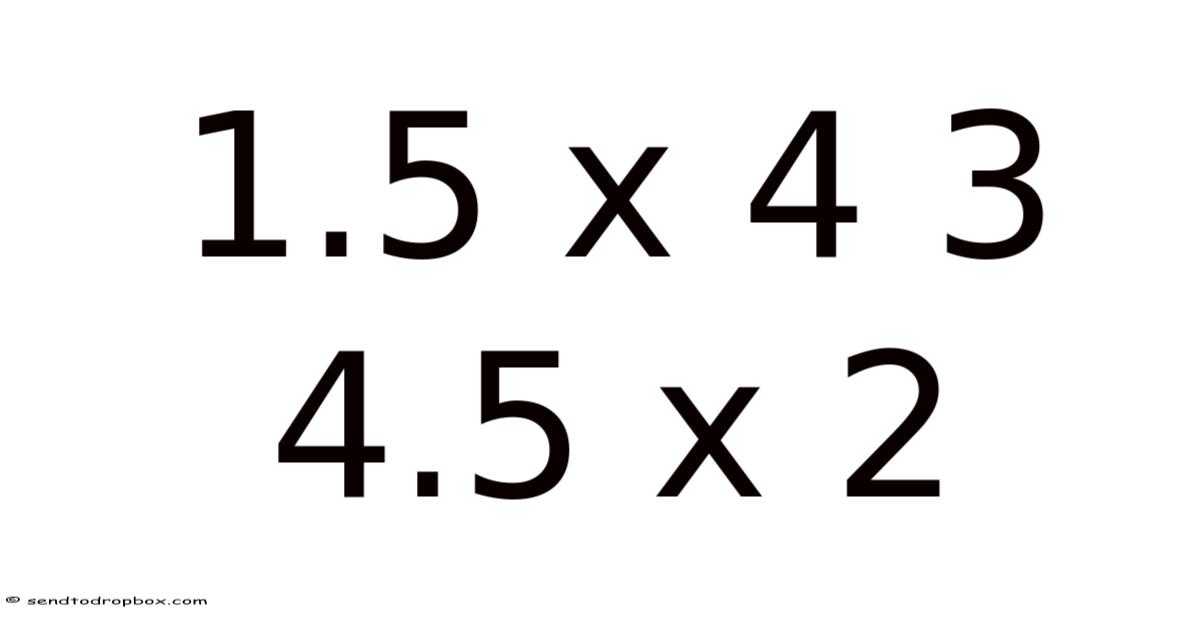
What Even Is 1.5 x 4 3 4.5 x 2?
Honestly, when I first saw this string of numbers — 1.Day to day, it looks like a math problem that got lost on its way to a lumberyard. On the flip side, 5 x 4 3 4. Also, 5 x 2 — my brain did a little backflip. But that's exactly what it is: a set of lumber dimensions, written in the shorthand that carpenters, builders, and lumberyard workers use every single day.
Let me break it down. The format is usually thickness x width x length, separated by the letter "x.In the lumber world, you'll see measurements written like this all the time. " So when someone writes "1.5 x 4 3 4 Surprisingly effective..
- A piece that's 1.5 inches thick, 4 inches wide, and 3 feet long
- A piece that's 4.5 inches thick, 4 inches wide, and... wait, that doesn't make sense.
Actually, let me re-read this. Even so, the "3" in the middle is throwing me off. Here's what's more likely happening: this is describing two different lumber sizes, and the "3" is either a typo, a quantity indicator, or part of a different notation system.
The short version is this: 1.Because of that, 5 x 2 would be a board that's 4. 5 inches by 4 inches, with "3" indicating either quantity or a third dimension. And 4.On top of that, 5 x 4 3 could mean a board that's 1. 5 inches by 2 inches. But without more context, we're guessing.
Why This Matters More Than You Think
Here's the thing — getting lumber dimensions wrong isn't just annoying. It's expensive. I've seen DIYers show up at the lumberyard with a list that says "2x4s" and walk away with actual dimensions of 1.Now, 5 x 3. 5 inches, completely confused about why their project is off by half an inch.
When you understand how lumber is actually measured and labeled, you save money, avoid trips back to the store, and build things that actually fit together the way you planned. This is especially true for anyone working with dimensional lumber — the pre-cut, pre-dried stuff you buy at Home Depot or Lowe's.
Real talk: most people think a "2x4" is literally 2 inches by 4 inches. It's not. 5 inches. That's why it's 1. Practically speaking, 5 inches by 3. The lumber industry has been doing this to us for decades, and honestly, it's a miracle any of our projects turn out square.
How Lumber Dimensions Actually Work
The Nominal vs. Actual Size Thing
This is where it gets weird. In practice, when you buy lumber, the size printed on the sticker — what's called the "nominal" size — almost never matches the actual dimensions of the wood. A 2x4 is actually 1.Practically speaking, 5 x 3. Day to day, 5 inches. A 1x6 is actually 0.75 x 5.5 inches. Always No workaround needed..
The reason goes back centuries. Originally, lumber was sold rough-sawn, and the nominal size was the actual size. So we're stuck with this system where a "1x" is actually 3/4 inch thick, and a "2x" is actually 1.In real terms, then mills started planing and drying the wood to make it smoother and more stable. But they kept the old names. 5 inches thick The details matter here..
Reading the Shorthand
When carpenters write dimensions quickly, they use a shorthand that can look like hieroglyphics to outsiders. Here's how to decode it:
- 1.5 x 4 = 1.5 inches thick, 4 inches wide
- 4.5 x 2 = 4.5 inches thick, 2 inches wide
- 3 by itself = usually means 3 feet long, or sometimes 3 pieces
But when you see something like "1.In real terms, 5 x 4 3 4. 5 x 2," it's typically three separate entries mashed together, probably because someone was writing fast or copying from a handwritten note.
Common Lumber Sizes You Should Know
Here are the actual dimensions for the most common lumber sizes you'll encounter:
- 1x2 = 0.75 x 1.5 inches
- 1x4 = 0.75 x 3.5 inches
- 1x6 = 0.75 x 5.5 inches
- 2x4 = 1.5 x 3.5 inches
- 2x6 = 1.5 x 5.5 inches
- 2x8 = 1.5 x 7.25 inches
- 2x10 = 1.5 x 9.25 inches
- 2x12 = 1.5 x 11.25 inches
Notice a pattern? The thickness is always 1.5 inches for 2x material and 0.75 inches for 1x material. The widths follow a predictable formula too.
Common Mistakes People Make
Forgetting About Thickness
I know it sounds basic, but so many people measure for width and length and completely forget about thickness. If you're building a shelf and need the supports to fit between two pieces of plywood, that plywood is actually 3/4 inch thick, not 1 inch. Your supports need to account for that.
Confusing Feet and Inches
This one kills me. But i've watched people at the lumberyard argue with the clerk because they asked for "four 2x4s that are 8 inches long" when they meant 8 feet. The clerk cuts them 8 inches long. Everyone's confused. Nobody's happy.
Not the most exciting part, but easily the most useful Simple, but easy to overlook..
Not Accounting for Kerf
Every time you make a cut with a saw, you lose about 1/8 inch to the blade itself. On the flip side, this is called kerf. Which means if you're cutting three pieces from one board, you need to account for the width of the blade three times. Miss this, and your pieces don't fit Surprisingly effective..
Practical Tips That Actually Work
Always Measure Twice, Cut Once (But Also Calculate)
Before you buy anything, calculate exactly what you need. If your project requires 12 pieces of 1.On top of that, 5 x 4 lumber at 3 feet long, write that down. Consider this: don't just guess. Include the actual dimensions, not the nominal ones It's one of those things that adds up. Simple as that..
Keep a Cheat Sheet
I have a small card in my tool belt that lists actual lumber dimensions. It saves me from doing math in my head every time I need to figure out if something will fit. You can print one online or just write the common sizes on a piece of tape stuck to your workbench.
Talk to the Lumber Yard Staff
These people have been dealing with confused customers for years. Consider this: they've heard every possible interpretation of lumber shorthand. So if you're not sure what "1. 5 x 4 3" means, ask. They'll help you figure it out, and you'll both end up less frustrated Small thing, real impact. But it adds up..
People argue about this. Here's where I land on it.
Account for Waste
Always buy a little extra. Plus, cut nothing perfectly on the first try. So if you need six 2x4s, buy seven. Trust me on this one.
FAQ
What does 1.5 x 4 mean in lumber? This refers to a board that's 1.5 inches thick and 4 inches wide. In actual lumber dimensions, this would be a piece of 1x4 material, which is planed down to 3/4 inch thick. So 1.5 x 4 likely means two 1x4s stacked, or it's referring to the rough-sawn dimensions.
How do I convert nominal lumber sizes to actual sizes? For 1x material, subtract 1/4 inch from the thickness and 1/2 inch from the width. For 2x material, subtract 1/2 inch from the thickness and 1/2 inch from the width. So a 2x4 becomes 1.5 x 3.5 inches And that's really what it comes down to..
What does the number after the x mean? Usually, it indicates length. In "1.5 x 4 x
What does the number after the x mean? Usually, it indicates length. In "1.5 x 4 x 8," the 8 refers to 8 feet. Still, context matters greatly—sometimes it could mean 8 inches, especially in smaller detailed work. Always clarify whether you're working with feet or inches, and confirm with your lumber yard staff to avoid costly mistakes.
Why is my lumber smaller than expected? Lumber is sold in nominal sizes, which are the dimensions before the wood is dried and planed. A "2x4" starts as a rough-cut 2x4 but finishes at 1.5x3.5 inches. This shrinkage occurs during the drying and smoothing process, so always account for actual dimensions rather than nominal ones.
How much extra lumber should I buy? Plan to purchase 10-15% more material than your calculations suggest. This accounts for cutting errors, defects in the wood, and any last-minute design changes. For larger projects, consider buying an entire bundle if the price difference is minimal—it's often cheaper than making multiple trips to the store.
Conclusion
Mastering lumber measurements isn't just about avoiding frustration—it's about building confidence in your craft. When you understand the difference between nominal and actual dimensions, account for blade kerf, and communicate clearly with suppliers, your projects go from guesswork to precision No workaround needed..
The key takeaway? Plus, whether you're a weekend warrior or a seasoned contractor, taking a few extra minutes to double-check measurements, write down actual dimensions, and ask questions will save you time, money, and countless headaches. Now, never assume. Your lumber yard staff wants to help you succeed, and a simple clarification can prevent expensive mistakes And it works..
Remember: measure twice, calculate once, and always account for that 1/8 inch blade width. Your next project will be stronger, fit better, and look more professional—and you'll wonder why you ever put up with the confusion before Not complicated — just consistent..
